









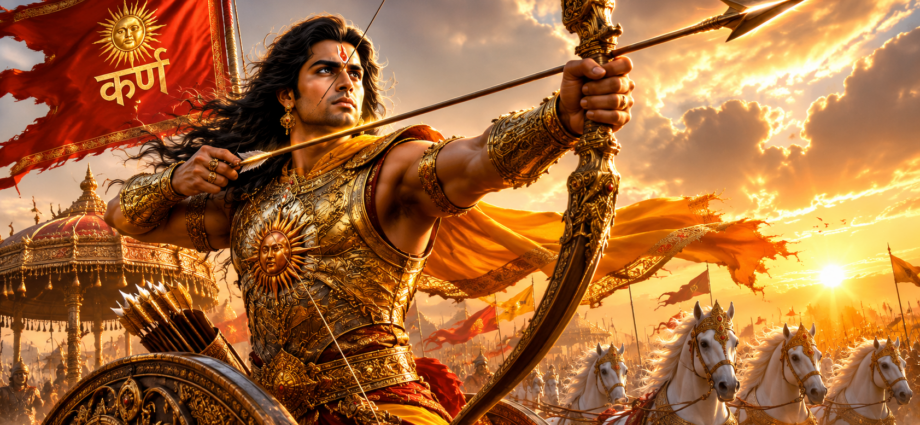
The epic of the Mahabharata is not merely a saga of war; it is a mirror reflecting human frailties and moral deviations. Karna’s character stands as the prime example of this complexity. While often viewed as an ‘antagonist’ (villain) due to his friendship with Duryodhana, he simultaneously embodies valor, generosity, and unwavering loyalty. In this article, we explore the truth behind Karna’s character based on facts from the original Mahabharata.
Karna’s Life Journey: From Son of a God to Son of a Charioteer
Karna was born under divine circumstances, yet his life was fraught with struggle. Born to the Sun God (Surya) after Kunti tested a mantra given by Sage Durvasa, he possessed innate armor (Kavacha) and earrings (Kundala). After Kunti set him adrift in the river to avoid social stigma, he was adopted by the charioteer Adhiratha and his wife Radha. Karna acquired knowledge from Parashurama, but upon the revelation of the truth, the sage cursed him, decreeing that he would forget his learning during the decisive battle. Ultimately, his decision to side with Duryodhana proved to be the pivotal turning point that defined the course of his life.

Karna’s Unrighteous Decisions: Embarking on the Path of “Adharma”
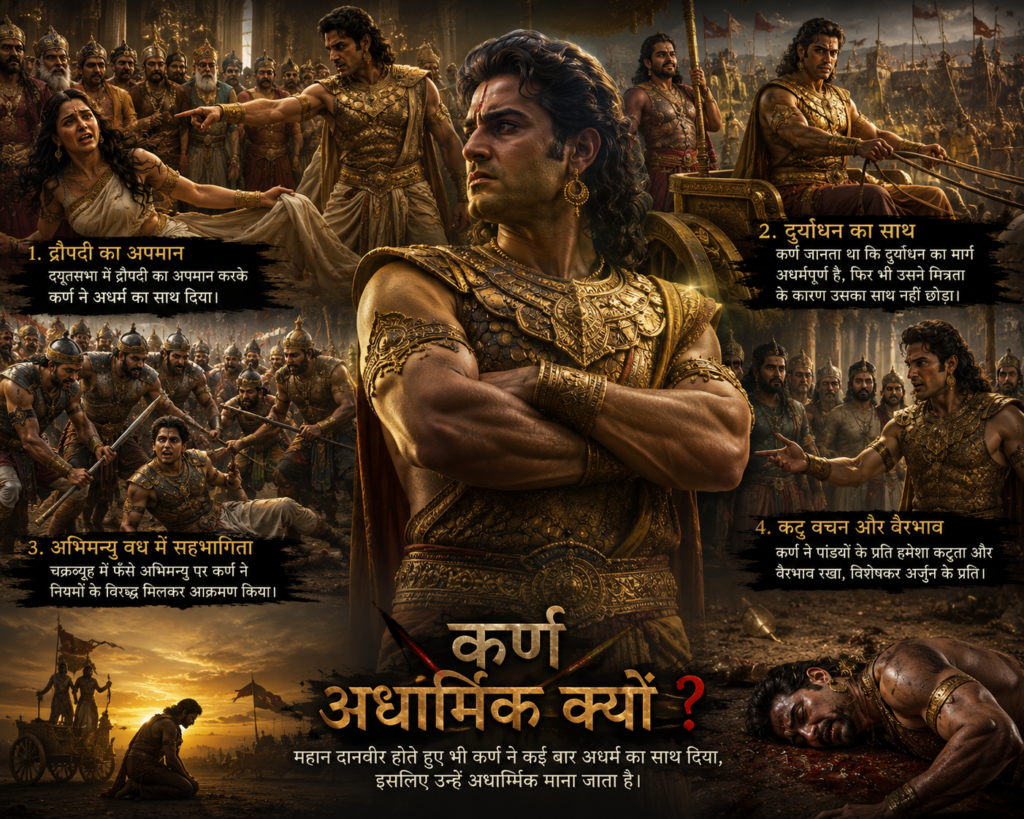
Karna if you see as an individual has been labeled as Villian by Sage Ved Vyasa. A person as a self is never regarded as good or bad but his deeds and its impact on culture, society and Prakriti makes an individual Dharmic or adharmic. So is the case with Karna because he made several decisions that led him down the path of adharma (unrighteousness).
Let’s begin with the time he was receiving his education from Dronacharya. He was envious of Arjuna right from that moment. His hatred for Arjuna was the reason Drona did not teach him the knowledge of the Brahmastra. Even later, when he sought the knowledge of the Brahmastra from Parashurama—attaining it through a lie by claiming to be a Brahmin—he was cursed that this vidya would fail him when he needed it the most. Even after acquiring the Bhargavastra and the Vijay Dhanush from Parashurama, he could not let go of his hatred for Arjuna. Driven by the need to prove his prowess and superior skills, he challenged Arjuna and came under the scrutiny of Duryodhana. Although Duryodhana made Karna the King of Anga, this gesture made Karna view Duryodhana as his best friend, and he felt bound by a sense of Rin (debt) to Duryodhana for granting him a bona fide status in society. Consequently, just to satisfy Duryodhana, he continued to make poor decisions.
- One of the most grievous stains on Karna’s character occurred during the aftermath of the Dyut Krida (the game of dice). When Duhshasana dragged Draupadi into the royal assembly, Karna—driven by sarcasm and a desire to bully—viciously labeled her a prostitute. He cruelly questioned what harm could come to her from being unveiled, given that she had married five men.
- Another grave misdeed attributed to Karna was his involvement in the Lakshagriha (the House of Lac) conspiracy. Alongside Duryodhana, Shakuni, and Dushasana, Karna helped craft the sinister plan to burn the Pandavas—along with the innocent Kunti—alive within the structure
- Ghosha Yatra was also to dismantle the peace of Pandavas in their exile. This Ghosh Yatra is famous for Gandharva yudha. Karna was prominent figure in conducting this Ghosh Yatra just to ruckus forests inhabitants but their primary target were Pandavas.
Perspectives on Karna’s Character
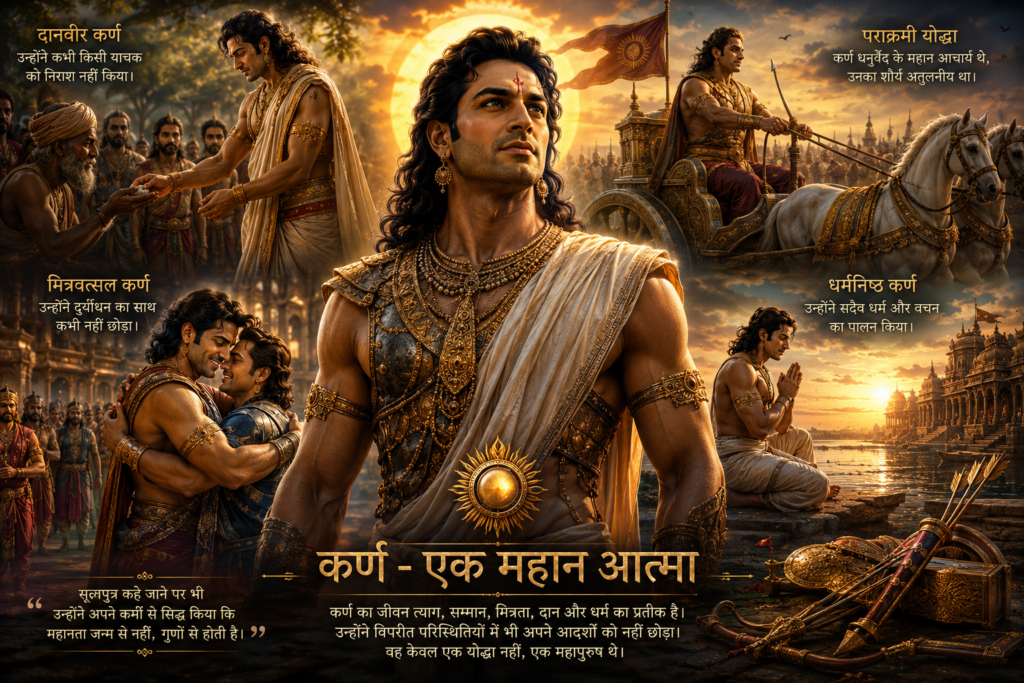
Vyasa designed the Mahabharata to show that human beings are deeply complex. He praised Karna’s truthfulness, vows, and charity (Dharma), while simultaneously highlighting how his bad choices and toxic associations dragged a magnificent soul down into destruction. In the Bhandarkar Oriental Research Institute (BORI) Critical Edition of the Mahabharata, Sage Vedvyas does not write Karna as a basic, black-and-white villain. Instead, Vyasa uses majestic imagery and deep praise to describe Karna’s physical appearance, personal virtues, and martial prowess.
In the Original Mahabharata, the title Vrisha (वृष) to Karna holds a deep, twofold meaning when used by Sage Vyasa and Lord Krishna. Vyasa Said “Karna is known as Vrisha because of his unwavering commitment to several virtuous qualities: his devotion to the Brahmanas, his commitment to truthfulness, his dedication to strict penance, his disciplined adherence to vows, and his capacity for compassion, even when dealing with his adversaries“
The Recognition of Bhishma
Bhishma, despite his frequent sharp rebukes toward Karna during the war, acknowledged his greatness as a fundamental reality of the battlefield. He recognized Karna’s prowess as being on par with Arjuna and Krishna themselves. Bhishma’s admiration was rooted in:
Valor and Skill: Bhishma knew that Karna’s heroism was difficult for even his greatest enemies to endure, noting his exceptional skill in archery, the use of celestial weapons, and agility.
Integrity: He lauded Karna as a “Brahman-devotee” (Brahman-bhakta) who was steadfast in his commitment to charity (dana).
Fearless Combat: Bhishma observed that in direct conflict, Karna fought with a ferocity comparable to a divine being, often appearing superior to ordinary men.
The Assessment by Krishna
Krishna, while maneuvering for the Pandavas’ success, provided perhaps the most poignant analysis of Karna’s nature. He identified the following virtues that defined the “Sun-born” warrior:
The Virtue of ‘Vrish’ (Righteousness): Krishna explicitly used the title Vrish (meaning one who is righteous or a virtuous soul) for Karna, citing his devotion to truth, his ascetic practices, and his observance of vows.
Compassion: Krishna noted that Karna possessed a rare mercy, even toward his enemies.
Unconquerable Spirit: Even after Karna was stripped of his divine armor and earrings, Krishna admitted that he remained so formidable that he could not be defeated by any warrior other than Arjuna, and even then, only through specific strategic intervention. Krishna compared him to a wild, roaring lion and a forest elephant that shatters the pride of opposing warriors.
The reverence for Karna is perhaps best encapsulated by the blessing of his teacher, Parashurama. Recognizing the greatness within his student, Parashurama prophesied:
“O Karna, whatever high heroic deeds you wish to perform in your life will certainly come to pass. Your fame and glory in this world will remain absolute and immense forever“.
Even in the context of the inevitable destruction of the war, these great figures—Bhishma and Krishna—saw beyond the allegiances of the battlefield. They recognized a warrior whose life was governed by a strict personal code of honor, loyalty to his friend Duryodhana, and a deep-seated commitment to his own dharma, cementing his status as one of the most enduring figures of the Mahabharata.
However, because Karna supported Duryodhana in his evil deeds, Vyasa described him as the “trunk” of the tree of Adharma (unrighteousness)—a tree embodied by Duryodhana himself.
Vedavyasa referred to Karna as the “trunk of the tree of Adharma” because Duryodhana relied entirely on him for his power. It was on the strength of Karna’s prowess that Duryodhana became arrogant and conceived ambitious schemes like the “Ghosh Yatra” (campaign of universal conquest). Karna could never shake off his personal animosity—specifically his envy of Arjuna—throughout his life. Driven by this hatred, he became—albeit reluctantly—the strongest foundation of that tree of Adharma.
Conclusion: Was Karna the sole villain?
In the Mahabharata, the failings of other great characters are just as evident as Karna’s. Dronacharya’s refusal to impart the Brahmastra to Karna out of attachment to his own son, or Bhishma Pitamah’s abduction of the princesses of Kashi—these were acts that transgressed the moral boundaries expected of ‘righteous men’ (Dharmatmas). Yudhishthira is considered the very incarnation of Dharmaraja, yet his participation in the game of dice (dyuta-krida) was his greatest moral and strategic failure.
Ultimately, it is unfair to label Karna solely as a villain or to regard him as the root cause of the entire Mahabharata. The primary instigator was Duryodhana himself, who used Karna merely as a tool. Karna’s only error was losing sight of Dharma amidst his hatred for Arjuna and his unwavering loyalty to Duryodhana. Undoubtedly, he was a villain; yet, it is essential to view him as a victim of circumstance—a figure whom the Mahabharata itself also acknowledges as a ‘Vrish’.
Now in the Words of Vidur from Udyog Parva of Mahabharata, let us explain Karna –
Vidura told Dhritarashtra that Karna was no ordinary man or warrior; rather, the core virtues of all five Pandavas were simultaneously present within him:
- Yudhishthira-like Righteousness and Integrity: Karna is as unyielding and steadfast in his sacred vows, commitments, and unparalleled charity as Yudhishthira.
- Bhimasena-like Physical Strength: Karna possesses monumental physical power, raw masculine muscle, and martial combat skills akin to a mighty, intoxicated elephant.
- Arjuna-like Concentration and Archery Mastery: Karna’s absolute focus, archery, and supreme command over cosmic weaponry match the flawless, pinpoint precision of Arjuna’s Gandiva art.
- Nakula-like Beautiful Form and Aura: Karna’s physical elegance, radiant aesthetics, and striking aura resemble the divine beauty of the gods.
- Sahadeva-like Intelligence and Strategic Wisdom: He is an exceptional scholar of the ancient shastras (scriptures), possessing a sharp, calculating mind and the traits of a shrewd military strategist.”
“O King! Even though Karna possesses the combined individual virtues of all five Pandavas, he will still fail to win this war for Duryodhana. This is because the Pandavas possess a singular, supreme weapon that Karna discarded: Absolute Alignment with Dharma and the Active Presence of Lord Krishna. Where there is Krishna, there is Dharma; and where there is Dharma, victory is mathematically and cosmically absolute.”