










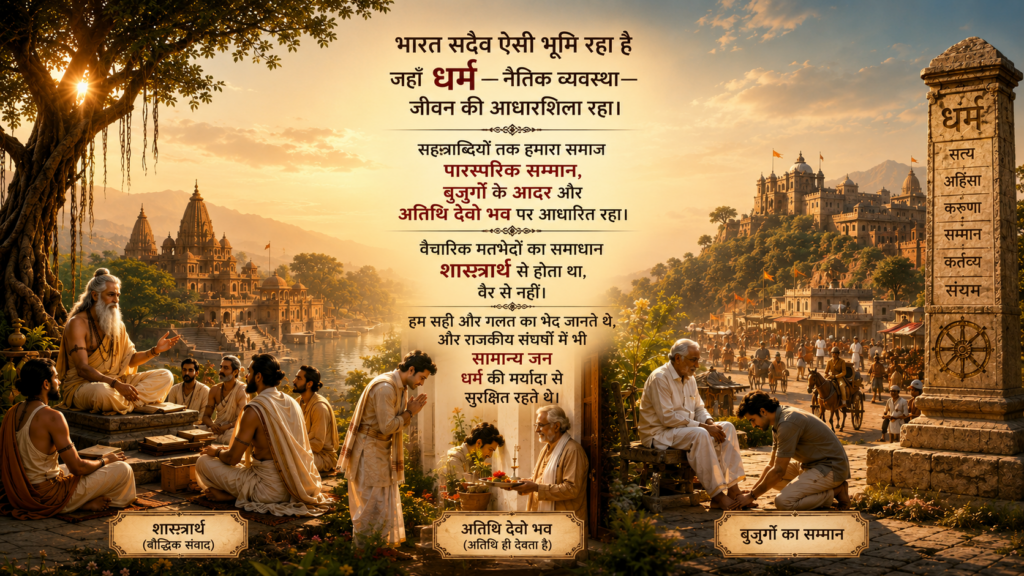
India has historically been a land where Dharma—the moral order—served as the cornerstone of existence. For millennia, the essence of our society was rooted in mutual respect, the veneration of the elderly, and the sanctity of the guest (Atithi Devo Bhava). Even when ideological differences arose, they were resolved through Shastrartha (intellectual discourse) rather than animosity. We understood the distinction between the right and the wrong, and even in times of royal conflict, the common citizenry remained shielded by this overarching moral framework.
Imperial Colonization and Decline of Dharma
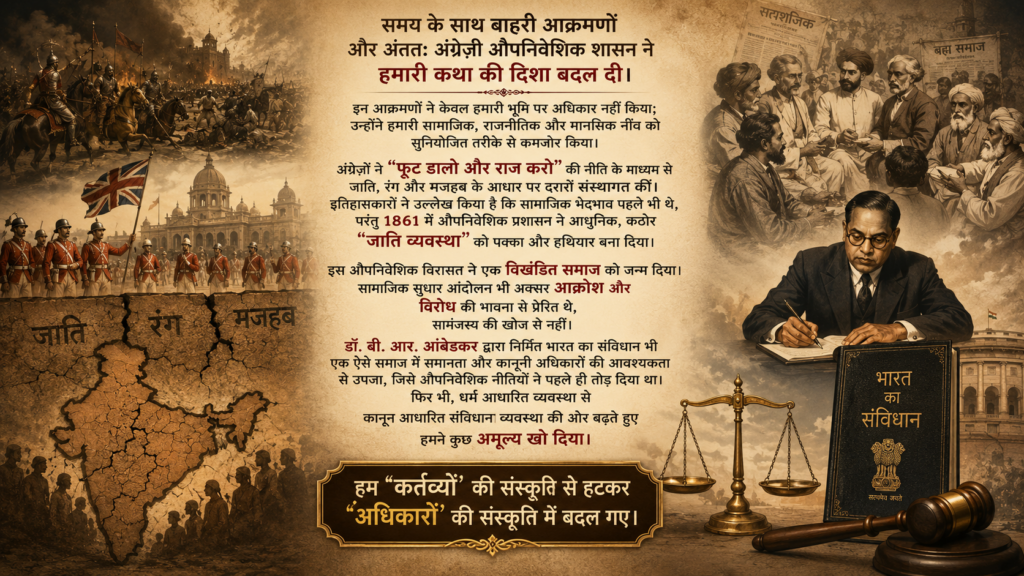
However, the narrative began to shift with successive waves of external aggression and the eventual British colonial occupation. These invasions did not merely conquer our land; they systematically dismantled our social, political, and psychological foundations. The British, through their policy of “divide and rule,” institutionalized fissures based on caste, color, and creed. Historians have noted that while social stratifications existed, the modern, rigid iteration of the “caste system” was solidified and weaponized by the colonial administration in 1861.
This colonial legacy left behind a fragmented society. Social reform movements, rather than seeking synthesis, were often born out of resentment and targeted antagonism. Even the Constitution of India, envisioned by Dr. B.R. Ambedkar, was necessitated by the need for equality and legal rights in a society already fractured by colonial policy. Yet, in our transition from a society governed by Dharma to one governed strictly by a legalistic Constitution, we lost something vital. We shifted from a culture of “duties” to a culture of “rights.”
Rights Vs Dharma
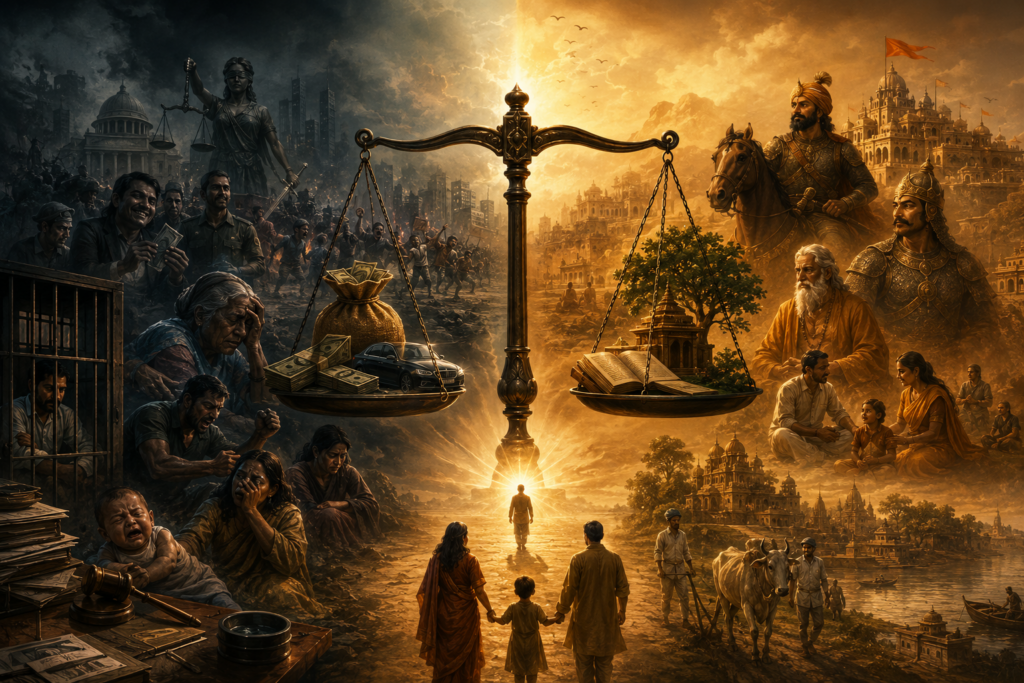
Today, the fear of the law is overshadowed by the technicalities of rights. We live in a system where criminals can secure bail and roam free, while the impoverished remain trapped in the gears of the legal process. In the age of Dharma, one’s duty was paramount; today, the individual is obsessed only with personal gain.
The symptoms of this moral collapse are harrowing. From the horrific assault of infants to the brutalization of the elderly; from domestic conspiracies where spouses are murdered for personal agendas to the systematic harassment of women within the household—the fabric of our society is tearing.
There is a profound disconnect in our legal infrastructure. While personal laws remain fragmented and often incomplete, our indigenous systems have been weakened, leading to a majority population that is essentially consuming itself. This internal decay is actively undermining the foundations of Sanatan Dharma. Instead of embodying the true essence of their faith, many are turning their sects into tools of superiority, leading to the destruction of the very values they claim to protect.
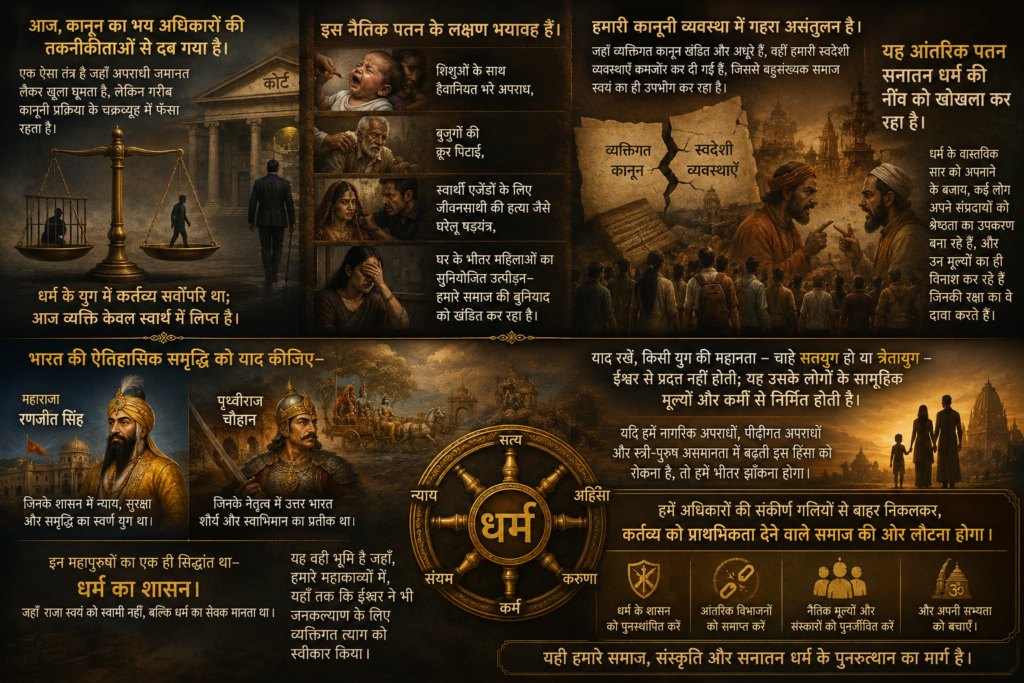
Consider the historical prosperity of India under leaders like Maharaja Ranjit Singh or the strength of North India under Prithviraj Chauhan. The common denominator was the “Rule of Dharma”—a system where the ruler viewed themselves not as a master, but as a servant of the moral order. This is the land where, in our epics, even the divine accepted personal sacrifice for the greater good of the people.
We must remember that the greatness of a Yuga—whether Satya or Treta—is not bestowed by the divine; it is crafted by the collective values and actions of its people. If we wish to halt this rise in civic, intergenerational, and intergender crimes, we must look inward. We must move beyond the narrow corridors of “rights” and return to a society that prioritizes “duty,” restores the rule of Dharma, and heals the internal fractures that are tearing our civilization apart.
The Mirage of Justice and the Crisis of Character
The current state of our legal system—what we call Aaj ka Kanoon—has reached a point of crisis. Justice, in the eyes of the common man, has become an illusion. The nexus between corrupt policing and the wealthy elite has hollowed out the judiciary’s efficacy. For the marginalized and the middle class, the law no longer serves as a protector; it is a burden that often penalizes those who follow it, while shielding those who exploit it. The judicial process is now so sluggish, so riddled with procedural delays, that the perpetrator often escapes long before any real accountability can be established.
This environment has fostered a culture of impunity. When the law fails to act as a deterrent, it ceases to be justice and becomes mere bureaucracy.
Simultaneously, we have witnessed the systematic disintegration of our educational values. We send our children to schools where they master the English language, excel at complex mathematics, and understand the intricacies of science. Yet, we have failed to teach them the most important subject of all: humanity. Our youth are becoming technical experts but moral cowards—analytical in their professional pursuits, yet incapable of solving the fundamental problems of life. They are conditioned to flee from adversity rather than face it.
The influence of a westernized, liberal, and materialistic mindset has stripped them of their roots. In the pursuit of hyper-individualism, the sense of duty toward family and community has evaporated. They have been taught to think only of themselves.
This decline is evident in our changing gender dynamics. A misplaced, “pseudo-feminism” has created a chasm, distancing women from the strength of traditional wisdom and trapping them in a performative cycle that lacks depth or real progress. Simultaneously, we see a growing intolerance toward women, born from the same lack of moral grounding.
The Path Forward: A Return to the Core
If we are to salvage our civilization, we must move beyond the reliance on broken institutions and return to the bedrock of our culture:
- Reviving the Home as a Sanctuary: We must stop outsourcing the character-building of our children to schools. The tradition of Satsang and open discussions on Dharma must return to our living rooms. Our children need to understand that success without character is merely a gilded failure.
- Decolonizing the Law: It is time to demand that the State reform our legal framework—not according to imported Western paradigms, but in alignment with our own Dharma Shastras. Our laws should reflect the values of the society they govern, not attempt to mold us into a culture that is fundamentally alien to our nature.
We are currently at a crossroads. We can continue to watch the slow collapse of our social fabric, or we can choose to be the generation that pivots. It starts by recognizing that Dharma is not a relic of the past; it is the only sustainable compass for our future.
What is Dharma?
We have been conditioned to believe that Dharma is synonymous with “religion” or a specific Puja Paddhati (method of worship). This is a fatal misunderstanding. Dharma has no English equivalent because it is not a belief system—it is the very architecture of sustainability. It is that which sustains life itself.
When we see the disintegration of family structures—where a daughter-in-law perceives her in-laws as a “burden,” or in-laws treat the woman as an outsider—we are not witnessing a conflict of personalities. We are witnessing the total absence of Dharma. When the sustaining principle of unity is absent, families fracture, and society begins to consume itself.
Dharma as the Guardian of Nature True Dharma operates in three spheres, all of which are currently in decline:
- Inner Nature (Antah-Prakriti): The mastery of one’s own ego and the cultivation of acceptance. Without internal stability, one cannot act with wisdom.
- Social Nature (Samajik-Prakriti): The harmony of norms within our community. It is the practice of aligning our individual conduct with the well-being of the collective.
- Environmental Nature (Bahya-Prakriti): The physical world. Our behavior toward plants, animals, and the environment is a reflection of our internal state.
When a human being lives in accordance with Dharma, they do not merely “behave well” with other people; they extend that same respect to the ecosystem, to their business ethics, and to their professional life. This is why ancient wisdom held that a King (or a leader) who ensures that Dharma is practiced in every household is blessed by the forces of nature themselves. When the collective energy of a society is aligned with the natural order, even the climate and weather systems find balance.
We have replaced this holistic sustainability with a narrow, westernized individualism that prioritizes “I” over “We.” We are trying to solve societal problems with laws that only govern the surface, while the root—our commitment to the natural order—remains untended.
To heal India, we must stop asking, “What are my rights?” and start asking, “What is my Dharma in this moment?” Whether as a spouse, a parent, a professional, or a citizen, our duty is to sustain the life around us. Only when we return to this definition can we hope to restore the prosperity and peace that our ancestors once called the “Golden Age.”
The Existential Imperative
India has, since the dawn of time, been the epicenter of Adhyatma (spirituality). It is the world’s enduring peacemaker, a nation that has historically championed Ahimsa (non-violence) not as a sign of weakness, but as a deliberate choice born of inner strength. Yet, we are also the inheritors of the timeless wisdom: Dharma Himsa Tathaiva Cha—that while non-violence is our path, the defense of Dharma against those who would destroy it is our ultimate duty.
We stand at a precipice. If the current trajectory of civic, intergenerational, and gender-based crime continues unabated, no amount of institutional reform or legal maneuvering will suffice. We are witnessing the slow, agonizing erosion of our moral compass, and if we allow this degradation to proceed, the very foundation of humanity will stagnate and wither long before its time.
The stakes could not be higher. Dharma is the essence of India; India is the hope of the world. If the light of Dharma is extinguished in India, the world loses its only true anchor of balance and sustainability. If India falls, the world loses its way.
The time for passive observation has passed. We must reclaim our values, restore the sanctity of our homes, and realign our lives with the laws of Dharma. This is not just a call for social reform; it is a call for survival—for our families, for our nation, and for the future of humanity itself.