









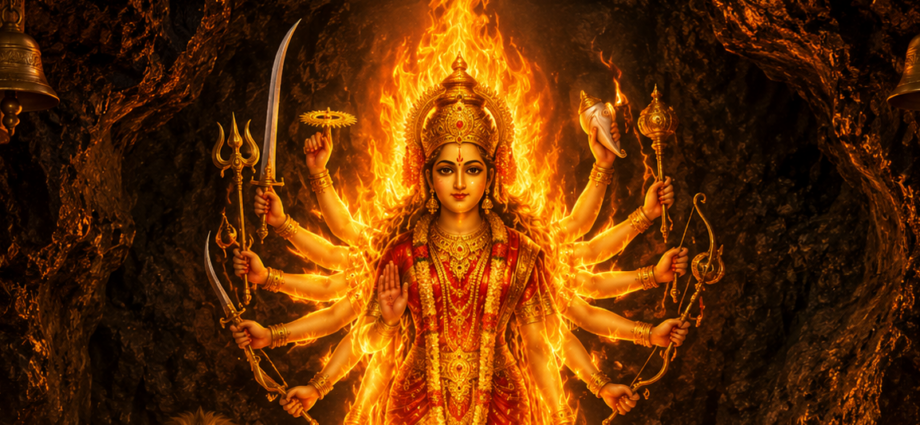
In previous article we detailed about Shiva Tatva, this article will dive in for Shakti’s Journey as Parvati and Sati, to know the reason how and Adi Shakti Durga manifested as Sati, Parvati, Nanda and Kalika, Wife of Rudra in four Yugas.
The story of Sati and Parvati is often narrated as two separate incarnations of Adi Shakti. However, I believe they are not two different journeys—they are two phases of the same cosmic evolution. The journey of Sati is incomplete without Parvati because Sati represents the concentrated, indivisible truth of creation, whereas Parvati represents the expansion of that truth into the living universe. Today in this cosmic journey, lets dive into the cosmic reality of the vast creation. Just as hormones govern our emotions, thoughts, desires, actions, and even our inner peace, Shakti governs the entire cosmic play. She is the dynamic force that activates, regulates, and directs the functioning of the universe.
Vishnu, the Supreme Sustainer, can be understood as the boundless ocean of spiritual consciousness—a divine reservoir that contains all Shree (Lakshmi), the abundance, harmony, and prosperity of the universe. Yet, like still water, this sustaining potential requires an active principle to manifest its purpose.
Shakti represents that active principle—the Divine Fire. She transforms potential into action, stillness into movement, and consciousness into creation. Without Shakti, even the sustaining essence remains unexpressed; without Vishnu, Shakti has no foundation upon which to sustain the cosmos.
To make this idea easier to understand, let me explain it in a practical manner.
The Lamp of Creation – A Philosophical Analogy
To understand the relationship between the Trimurti, Adi Shakti, and the cosmos, imagine the entire creation (Srishti) as a traditional oil lamp (Deepa). Every component of the lamp represents an eternal cosmic principle. Individually, none can illuminate the world; only when all exist together does creation become alive.
Shesh (Ananta) is the space or the infinite region in which the lamp exists. Just as a lamp cannot exist without space, the universe cannot manifest without the infinite foundation represented by Ananta, upon whom all worlds rest.
The oil within the lamp represents Narayana, the sustaining essence of existence. Oil is the reservoir of life, nourishment, and continuity. Without oil, the lamp cannot burn. Likewise, Narayana is the sustaining consciousness that preserves creation and provides the energy through which all life continues.
The wick represents Brahma, or Sharira (the body). The wick gives form to the oil, making it capable of becoming light. In the same way, Brahma provides structure, form, and manifestation to creation. Yet, by itself, the wick remains lifeless.
The matchstick symbolizes Yajna—effort, sacrifice, discipline, and invocation. Fire does not appear automatically. It is awakened through conscious action. Yajna represents every act of tapas, devotion, and cosmic effort that invokes divine energy into manifestation.
The flame is Shakti herself—Durga, Narayani, the living divine power. The flame is what transforms inert components into living light. Oil, wick, and effort all exist for the purpose of manifesting this radiant energy. Without the flame, the lamp possesses every ingredient for illumination yet remains in darkness. Shakti is therefore not merely another component of creation; she is the very principle that animates it.
Yet even the flame cannot exist independently.
The air that sustains the flame represents Shiva. Air is invisible, subtle, and all-pervading. A flame deprived of air immediately extinguishes. Likewise, Shakti performs her cosmic functions only in the presence of Shiva, whose infinite consciousness silently supports every manifestation of energy. Shiva does not produce the flame, nor does He consume the oil; He provides the subtle, formless support without which Shakti cannot continue to shine.
Thus, creation is not sustained by any single deity alone. It is a perfect union of eternal principles:
- Ananta (Shesh) – the infinite space that holds creation.
- Narayana – the sustaining essence (oil).
- Brahma – the manifested body and form (wick).
- Yajna – the effort and sacrifice that invokes divinity (matchstick).
- Durga (Shakti) – the living flame that illuminates and activates creation.
- Shiva – the subtle consciousness (air) that sustains the flame.
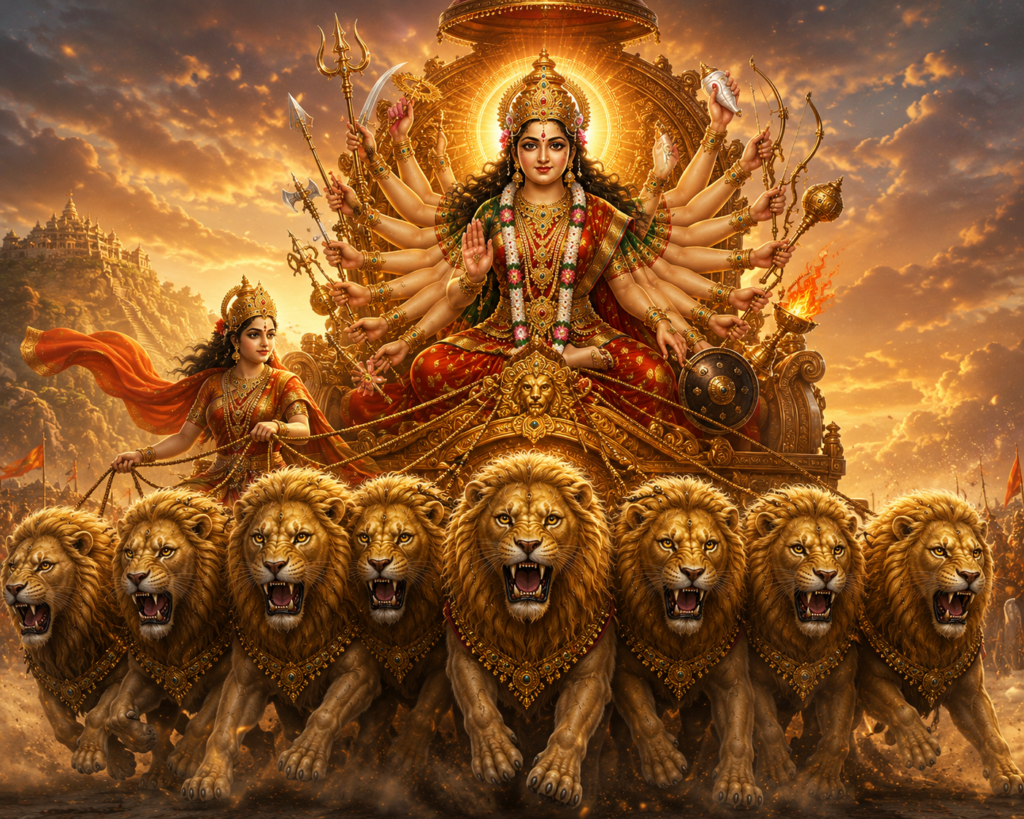
Only when all these principles work together does the lamp of creation shine. Remove any one of them, and the lamp ceases to fulfill its purpose. In this way, the universe is not the work of separate powers acting independently but of one interconnected cosmic process, where every divine principle supports and completes the others. Let’s come back to Shakti’s Journey.
Sati – The Unified Source of All Shakti
The name Sati itself carries profound meaning. She is not merely Daksha’s daughter or Shiva’s consort; she is the Mool Shakti, the primordial union of every divine force that would later manifest throughout creation. Before creation required diversity, every form of energy existed within one supreme consciousness. Sati embodied that complete and undivided power.
This is why the age in which she manifested came to be known as Satya Yuga—the age where truth (Satya) existed in its purest and most unified form. At that stage, the universe did not require multiple manifestations of Shakti because all energies remained united in Sati herself.
Why the Transformation Became Necessary
As creation evolved through Treta, Dwapara, and Kali Yuga, the universe itself became increasingly diverse and complex. A single concentrated form of Shakti could no longer sustain every aspect of cosmic existence.
Therefore, the Palankarta (the Sustainer) distributed not only Vedic knowledge but also the divine energies required for sustaining creation. Different aspects of Shakti had to become accessible to different beings, regions, and spiritual paths.
This transition marks the reason why the story could not end with Sati.
Daksha and the Rigidity of Limited Truth
In this interpretation, Daksha symbolizes more than an individual king.
He represents the arrogance that arises when one mistakes partial truth for absolute truth.
Daksha became rigid because he remained attached only to his own understanding of Satya. His ego allowed him to recognize only the order represented by Vishnu while failing to comprehend the transcendental reality embodied by Shiva.
His attachment to his own truth prevented him from seeing the completeness of cosmic truth.
Thus, Sati’s self-immolation is not merely an emotional act. It symbolizes the dissolution of a form of truth that could no longer evolve while surrounded by rigidity and ego.
Why Sati Had to Become Parvati
Sati represents Satya Ki Shakti—the power of absolute truth.
Parvati represents Param Yuvati—the eternally renewing force of creation.
When Sati reappears as Parvati, Shakti is no longer confined to one indivisible manifestation. Instead, she begins expressing herself in countless forms according to the needs of creation.
Parvati therefore completes what Sati began.
She transforms truth into compassion, austerity into nurturing, unity into diversity, and absolute consciousness into living experience.
Without Parvati, Sati would remain the origin but never become the sustainer.
The Significance of the Shakti Peethas
The Shakti Peethas, in this interpretation, are not merely sacred places created because parts of Sati’s body fell upon the earth.
They represent the gradual awakening of divine energy throughout the world.
As Parvati manifested in different forms, these sacred centres became focal points through which humanity could experience specific dimensions of the Divine Mother.
Each Peetha represents a unique vibration of the same original Shakti.
The Progressive Expansion of Shakti
According to this philosophical understanding, the manifestation of Shakti unfolded progressively with each Yuga.
- During Treta Yuga, approximately 51 Shakti Peethas became active.
- During Dwapara Yuga, the divine energy expanded further through 64 Shakti Peethas.
- In Kali Yuga, the evolution of consciousness moves toward the awakening of 108 sacred centres, representing a broader manifestation of the Divine Mother for humanity.
This progression symbolizes not the multiplication of different goddesses but the gradual unfolding of one eternal Shakti into increasingly accessible forms.
The Completion of the Divine Journey
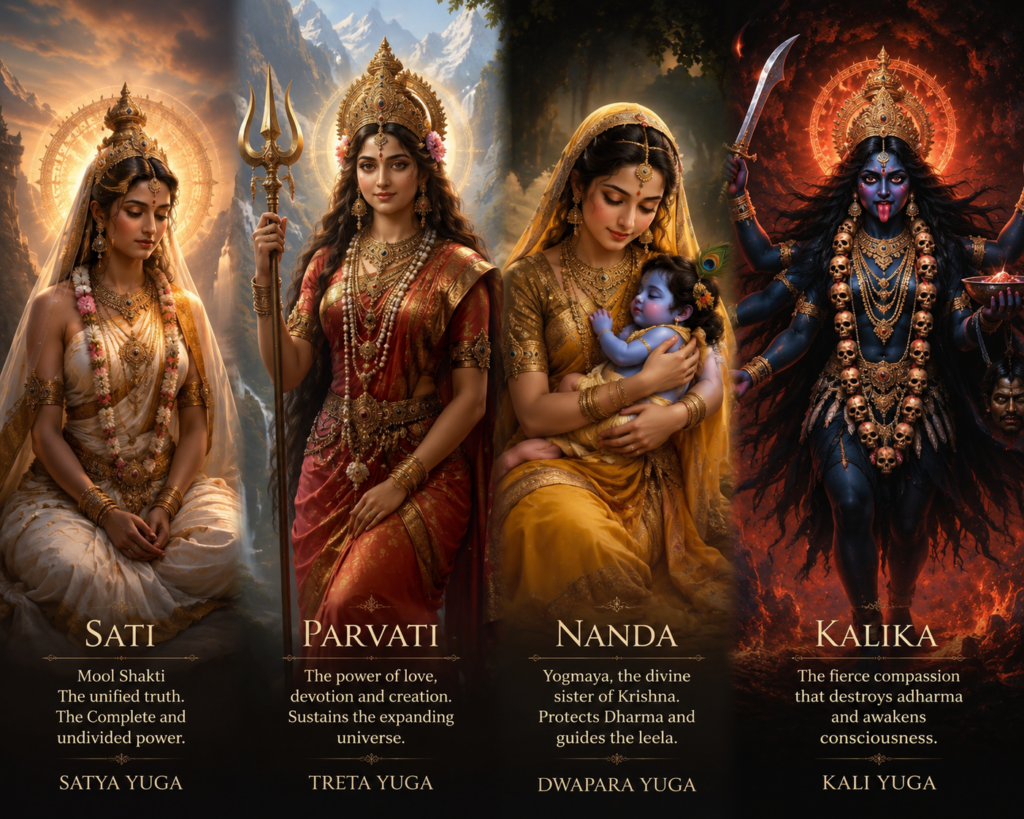
The journey of Sati is therefore incomplete without Parvati because Sati establishes the source, while Parvati fulfills its purpose.
- Sati is the origin of Shakti as unified true shakti.
- Parvati is the evolution of Shakti into 52 aspects of life.
- Nanda liberated 64 sciences to spread the development.
- When Development starts imbalancing the cosmos, then Kalika through 108 (Bhav of complete its fate when development starts imbalancing the cosmic order.
Another important aspect of this journey is that Narayani, Durga, or Uma—the eternal sister of Maha Vishnu and the primordial sustaining Shakti—assumes different manifestations in every Yuga to preserve cosmic balance. Though her names and forms change, the consciousness remains one.
In Satya Yuga, Narayani manifests as Sati, the complete and undivided embodiment of Mool Shakti, where all divine energies exist in their unified state. Her role is to establish the foundation of Satya itself.
With the changing needs of creation in Treta Yuga, the same Narayani reappears as Parvati. Here, Shakti is no longer merely the power of Truth but becomes the power that actively nurtures, protects, and sustains the expanding universe. Through Parvati, the Divine Mother manifests innumerable forms to accompany Shiva in preserving cosmic order.
In Dwapara Yuga, the same eternal Shakti manifests as Nanda (Yogmaya), the divine sister of Krishna. Her role is to conceal and reveal the Divine according to Dharma, protecting the incarnation of Vishnu and guiding the cosmic play (Leela).
Finally, in Kali Yuga, Narayani manifests as Kalika, the fierce yet compassionate force who destroys Adharma, ego, and ignorance. In the age of darkness, the Mother reveals her most transformative form, empowering humanity to overcome spiritual decline and reawaken divine consciousness.
Thus, Sati, Parvati, Nanda, and Kalika are not separate goddesses but successive manifestations of the same eternal Narayani, who descends in every Yuga according to the needs of creation. As Dharma evolves through the four Yugas, so too does the expression of the Divine Mother—from the undivided Truth of Sati, to the nurturing power of Parvati, to the protecting Yogmaya as Nanda, and finally to the transformative force of Kalika.
Together they reveal that the Divine Mother is not static. She evolves with creation, adapts to its needs, and manifests in countless forms without ever ceasing to be One. That’s why Vedas considered Shakti as Aditi, Agni (Durga), Sri and Vak.
In this way, Sati and Parvati are not two separate goddesses but two inseparable chapters in the eternal journey of the same Adi Shakti. Without Parvati, the story ends with sacrifice. With Parvati, it culminates in renewal, preservation, and the continuous awakening of divine consciousness across the universe.