


Long before 2014,
India was grappling with a multitude of deep-seated crises. At the forefront of these challenges were rampant corruption, rising crime rates, a sluggish and declining economy, and a widespread sense of policy paralysis. Amidst this despair, longing for the promise of Acche Din (good days) to finally arrive, the nation turned its gaze toward the BJP, bringing forward the then-Chief Minister of Gujarat, Narendra Damodar Das Modi.
The name quickly became a global phenomenon, trending across borders and captivating international attention. His magnetic aura, sharp and decisive political image, and commanding presence deeply resonated with the masses, culminating in the powerful campaign slogan: “Abki baar Modi Sarkaar.”
At the same time, years of persistent political corruption under the Congress regime—often characterized by the public as loot ki rajniti—alongside growing frustration over perceived anti-Hindu narratives and appeasement politics, created the ultimate political vacuum. This widespread public fury paved the way for the historic rise of the BJP at the Centre, fueled by the promise of transparent, strong, and decisive leadership.
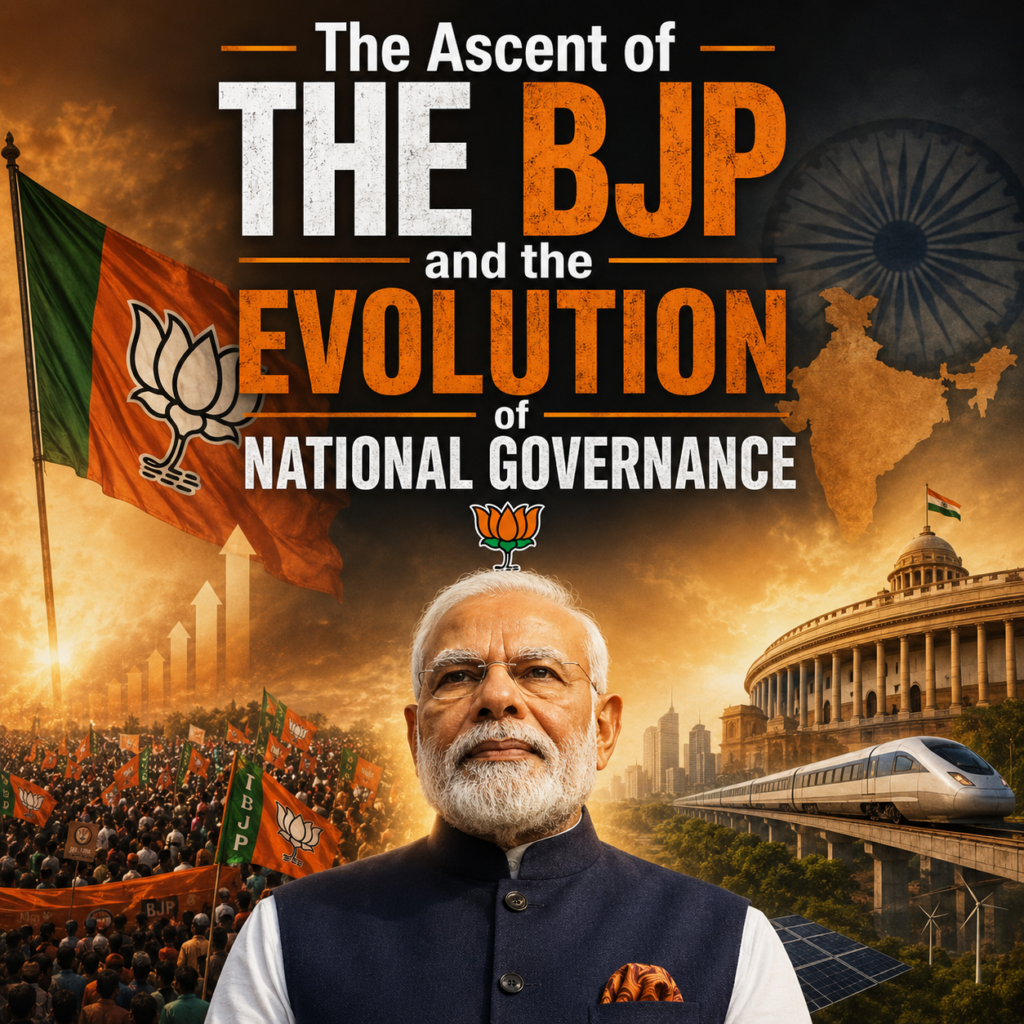
The Ascent of the BJP and the Evolution of National Governance
With Narendra Modi assuming office as Hon’ble Prime Minister for his first term, a new chapter in India’s political trajectory began. While Atal Bihari Vajpayee’s leadership is historically regarded as laying the foundational groundwork for a BJP-led government at the Centre, the Modi era ushered in a different scale of execution. In its initial phase, the administration rolled out high-impact structural initiatives like the Jan Dhan Yojana and the Swachh Bharat Abhiyan, which were aggressively implemented and widely felt on the ground. This was followed by demonetization—a bold, highly decisive, and fiercely debated move aimed at tackling corruption and fake currency infiltration. While it drew polarizing reactions initially, many economic experts later acknowledged its role in formalizing parts of the economy.
Economic Shifts and Policy Milestones
Another major structural pivot was the rollout of the Goods and Services Tax (GST) to replace the old VAT structure. This too faced mixed public reception. While the Congress party claimed it was originally conceptualized during the Manmohan Singh administration, critics argued that everyday essentials and petroleum products should have been brought under its umbrella. The government deflected this by maintaining that fuel, gas, and alcohol fall under state jurisdiction. Despite these friction points, these policies did little to dent Modi’s political momentum; if anything, his appeal continued to expand.
National Security and Modi 2.0
The turning point in cementing an invincible image of decisive leadership came through his hardline stance against cross-border terrorism. The URI surgical strikes and the Balakot airstrikes—executed as a direct, calculated response to the martyrdom of 40 soldiers—catapulted his public standing to unprecedented heights. Consequently, the 2019 general elections delivered a massive mandate, returning the BJP to power with a commanding absolute majority on its own.
Modi 2.0 was significantly more formidable, backed by the central administrative muscle of Home Minister Amit Shah. India’s global standing underwent a massive transformation, with Modi cementing his place among the world’s most powerful and influential leaders. Post-2019 milestones—such as the abrogation of Article 370, the implementation of the CAA, the NRC discourse, and the Triple Talaq Amendment—further projected a strong, unyielding political aura globally. Economically, India surged forward, maintaining its status as one of the fastest-growing major economies, witnessing a steady rise in per capita income, a decline in poverty rates, and cementing its position among the world’s leading economic powerhouses.
The Turning Point: Grassroots Discontent and the 2024 Reality Check
However, deep-seated friction began to surface around 2023, most notably marked by the intense farmers’ protests against the Minimum Support Price (MSP) framework and agricultural policies.
This widespread agitation deeply alienated rural demographics and diluted the BJP’s stronghold across key agrarian and regional belts—particularly in Punjab, western Uttar Pradesh, pockets of southern India, and Himachal Pradesh. The political fallout manifested clearly in the 2024 general elections, where the BJP fell short of the absolute majority mark on its own, getting restricted to around 240 seats. While the National Democratic Alliance (NDA) comfortably retained power, the electoral outcome was a clear signal that the public was no longer willing to write a blank check based purely on party strength.
Paradoxically, in subsequent state-level legislative battles (such as in Haryana and Maharashtra), the BJP and its allies demonstrated exceptional resilience, even making major inroads in regions like West Bengal. But political analysts note that these regional victories were less about an unshakeable wave of pro-incumbency love for Modi and more about the lack of a cohesive, equally strong challenger on the opposition front.
Today, driven by a politically conscious Gen Z and shifting societal priorities, the nature of national discourse has fundamentally evolved. Traditional narratives are being questioned, marking a fascinating turning point: even under the shadow of a deeply popular Prime Minister, the absolute grip of unbridled political authority is slowly loosening.
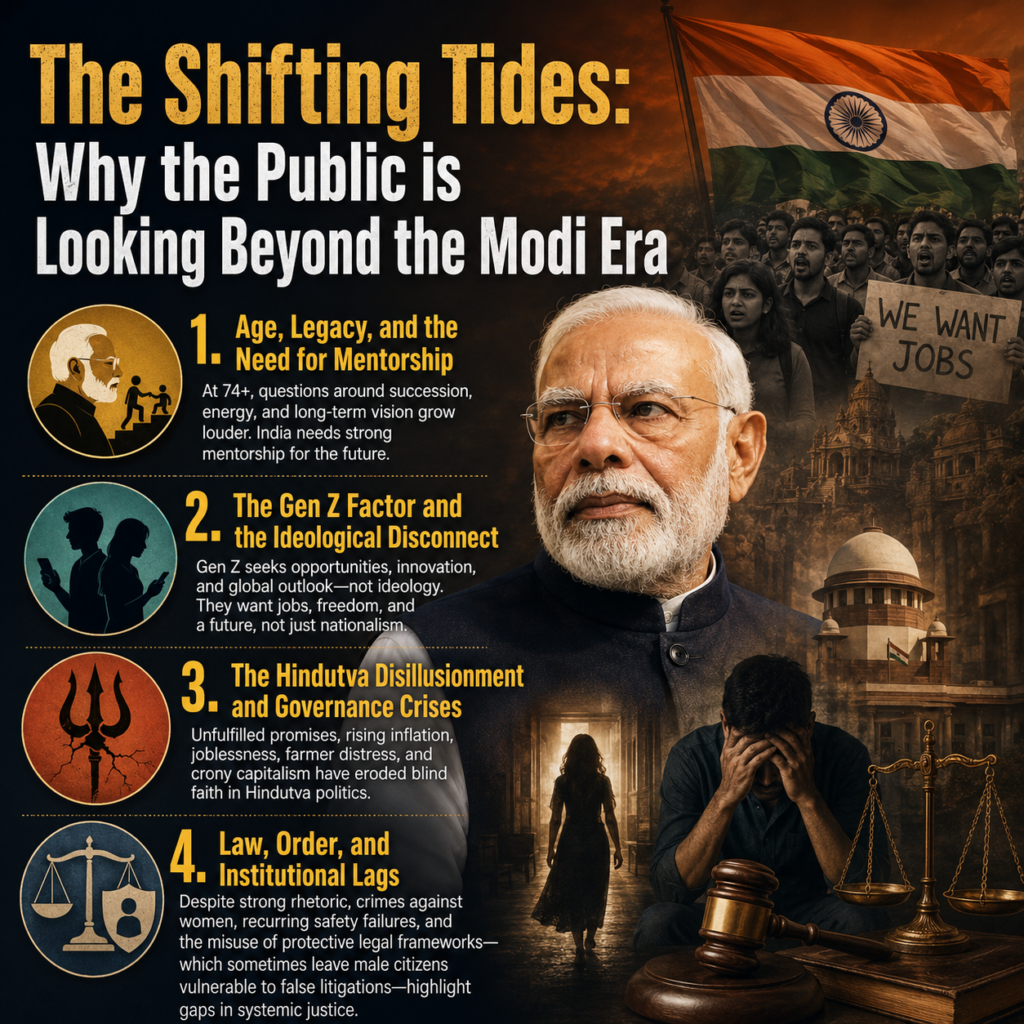
The Shifting Tides: Why the Public is Looking Beyond the Modi Era
A clear barometer of this changing political tide is the sharp surge in Google search queries asking, “Who will become the Prime Minister of India after Narendra Modi?” This rising curiosity delivers a profound message: even citizens who firmly championed Modi and his legacy are now increasingly eager to envision a future beyond his leadership.
1. Age, Legacy, and the Need for Mentorship
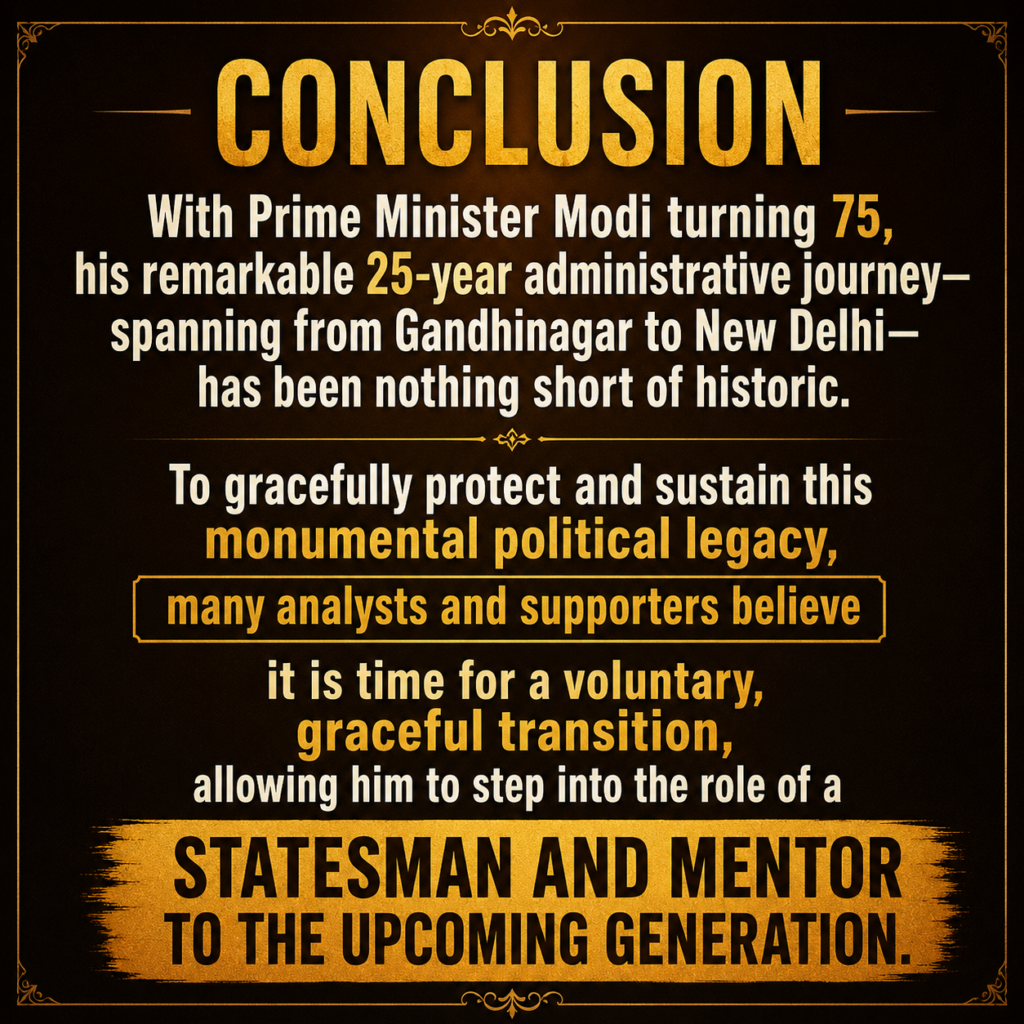
The foremost factor is generational and biological reality. With Prime Minister Modi turning 75, his remarkable 25-year administrative journey—spanning from Gandhinagar to New Delhi—has been nothing short of historic. To gracefully protect and sustain this monumental political legacy, many analysts and supporters believe it is time for a voluntary, graceful transition, allowing him to step into the role of a statesman and mentor to the upcoming generation. This does not question his relentless zeal, drive, or historical intentions; rather, it acknowledges the natural limits of time and the necessity of leadership renewal.
2. The Gen Z Factor and the Ideological Disconnect
A second major driver is the massive cultural and demographic shift. The rise of youthful political aspirations has altered how citizens evaluate leaders. Gen Z, heavily influenced by digital culture and visual branding—a playbook partly mastered and popularized by Modi’s own political communication—now demands a different kind of engagement.
Today’s India bridges the divide between the 1960s generation and the post-2005 digital natives. This creates a vast, diverse policy gap: one demographic values patient, traditional political loyalty, while the other is fast-paced, highly digital, and critically impatient with systemic stagnation.
3. The Hindutva Disillusionment and Governance Crises
Frustration is also brewing deep within traditional nationalist and Hindutva-aligned communities, who increasingly feel that the Modi government is making compromises and risking becoming “Congress Part 2.”
- The Ayodhya Ram Mandir Controversy: The severe scandal surrounding the alleged multi-crore embezzlement and theft of sacred donations at the Ram Janmabhoomi temple in Ayodhya has deeply demoralized devotees. Strong observations by the judiciary regarding systemic corruption have dealt a heavy blow to the moral high ground of the administration, leaving millions feeling betrayed.
- The Optics of Devotion: Incidents like tone-deaf campaign optics—such as an artist performing in a monkey-mask (Vaanar Mukhi) character ahead of political motorcades—have invited sharp public criticism, alienating core supporters who feel that Hindutva has sometimes been reduced to superficial tokenism rather than genuine cultural reverence.
4. Law, Order, and Institutional Lags
On the governance front, public frustration grows as criminal accountability continues to lag behind events. Despite strong rhetoric, crimes against women, recurring safety failures, and the misuse of protective legal frameworks—which sometimes leave male citizens vulnerable to false litigations—highlight gaps in systemic justice. Compounded by nationalflashpoints like the relentless NEET paper leak controversies, which have repeatedly placed the administration in the dock, public confidence in flawless institutional delivery has taken a hit.
Humaari Baat Presepective
Ultimately, these cumulative pressures prove that Narendra Modi no longer commands the frictionless, absolute political outcomes he once did. While the fundamental weakness of a cohesive, formidable national opposition continues to shield the ruling dispensation from immediate collapse, the writing on the wall is clear: the era of unquestioned, singular political dominance is giving way to a more demanding, restless, and discerning India. India needs Rule of Dharma to Sustain.