







In the late 19th century, direct British interference in Indian cultural, religious, and societal administration significantly altered the social fabric of the subcontinent. Through manipulated translations of texts like the Manusmriti by colonial scholars such as Sir William Jones and Georg Bühler, the British codified and rigidified a fluid indigenous social structure into a permanent system of division, transforming ancient societal norms into instruments of class stratification. The narrative surrounding social stratification intensified as colonial administrative policies began integrating Scheduled Castes into government offices prior to the 1930s, escalating existing societal fractures. Amid this complex backdrop, Dr. B.R. Ambedkar critically assessed the role of the colonial administration, noting:
“The British Government has no data or desire to wipe out untouchability. Before the British, you could not draw water from the well. With the British bureaucracy in power, can you draw water from the well today? […] We must stand on our own feet and fight as best as we can for our rights.”
He further observed how marginalized communities viewed the situation:
“The Depressed Classes have traditionally welcomed the British as their deliverers from the tyranny and oppression of the Orthodox Hindus.”
While Ambedkar recognized the colonial state as a counterweight to orthodox oppression to secure essential rights, critics argue this perspective overlooked historical frameworks inherent in Western and biblical structures. Ultimately, through this convergence of colonial intervention, shifting socio-political dynamics, and Ambedkar’s relentless advocacy for social justice, the framework of reservation was woven into the foundation of the Indian Constitution.
Passing the Reservation Bill in the Indian Parliament for the First Time
The legal and constitutional foundation of reservations in independent India did not happen inside the original text of the 1950 Constitution alone—it was forged in a fierce legislative battle just a year later through The Constitution (First Amendment) Act, 1951, which officially introduced Article 15(4) to empower the state to make special provisions for socially and educationally backward classes.
The legal and constitutional foundation of reservations in independent India did not happen inside the original text of the 1950 Constitution alone—it was forged in a fierce legislative battle just a year later through The Constitution (First Amendment) Act, 1951, which officially introduced Article 15(4) to empower the state to make special provisions for socially and educationally backward classes.
The Trigger: The Supreme Court Verdict that Shook the State
The catalyst for this legislative showdown came from the landmark 1951 Supreme Court case State of Madras v. Champakam Dorairajan.
- The Madras government had been utilizing a communal G.O. (Government Order) to allocate fixed quotas for medical and engineering college seats based on caste and community.
- The Supreme Court struck down the practice, ruling that caste-based quotas violated the fundamental right to non-discrimination under Article 15(1) and Article 29(2).
The ruling created a massive political firestorm, threatening affirmative action policies across several states and forcing Prime Minister Jawaharlal Nehru’s government to take immediate legislative action to override the judiciary.
The Parliamentary Timeline and Debates: B.R. Ambedkar vs. Jawaharlal Nehru on the House Floor
Introduction Date: Prime Minister Jawaharlal Nehru formally introduced the historic First Amendment Bill in the provisional Parliament on May 10/12, 1951.
For nearly four weeks, the provisional Parliament witnessed some of the most intense, heated arguments in Indian legislative history. Critics and opposition members warned against institutionalizing permanent social divisions and expanding state power over fundamental rights. Despite his own ideological reservations regarding identity-based quotas, Nehru pushed the measure through to uphold the state’s mandate for social equity.
The 1951 parliamentary debate on the First Amendment sparked a profound ideological clash between Jawaharlal Nehru and Dr. B.R. Ambedkar. Nehru reluctantly backed quotas due to intense political pressure following the Champakam Dorairajan ruling, yet he deeply feared that institutionalizing caste identity would compromise administrative standards and fracture national unity.
Conversely, Ambedkar fiercely argued that formal legal equality was an illusion that merely preserved historic oppression. He insisted that the state must possess uncompromised authority to dismantle centuries of social tyranny through targeted upliftment. While Nehru prioritized building a modernized, merit-oriented secular republic, Ambedkar maintained that true democracy could never exist without absolute social justice. This historic confrontation between two visionary leaders permanently shaped the complex, double-edged architecture of Indian affirmative action that defines our public discourse today.
Date of Passage: The Bill was officially passed by Parliament and enacted into law on June 18, 1951.
This amendment inserted Article 15(4) into the Constitution, creating the formal legal mechanism for reservations and permanently altering the architecture of Indian social policy.
When the framers of the Constitution inserted a 10-year limit on reservations in 1950, it was designed as a temporary bridge to close a historic gap. The expectation was that a decade of targeted political representation and state support would eradicate centuries of systemic inequality, rendering quotas obsolete.
How initial 10 year clause became political reality?
Instead of phasing out, the provision became a permanent fixture of Indian democracy through continuous constitutional amendments. Several critical factors drove this shift:
1. The Deep Roots of Socio-Economic Disparities
Ten years proved to be an impossible blink of an eye to reverse millennia of social exclusion, educational deprivation, and economic backwardness. By 1960—and at the turn of every subsequent decade—data and ground realities made it clear that marginalized communities had not achieved true social or economic parity. Dismantling a deeply entrenched hierarchy required far more than a single generation of affirmative action. Over time, the political narrative surrounding reservations shifted. What was initially conceived as a temporary remedial crutch gradually transformed into a permanent structural mechanism for political power-sharing and social security. Because structural discrimination and caste-based voting patterns persisted in Indian society, quotas remained the primary tool for marginalized groups to secure legislative presence and institutional protection.
The 10-year limit ultimately collided with the stubborn reality of social change, proving that transforming a nation’s social fabric takes generations, not years.
How Affirmative Action Deepened Societal Fractures
The original vision behind affirmative action was clear: bridge the historical gap, eradicate untouchability, and integrate marginalized communities into the mainstream. However, decades down the line, a critical paradox has emerged on the ground. While reservations were meant to foster social harmony, many argue they have inadvertently widened the emotional and social gulf between the General/OBC categories and the SC/ST communities.
1. The Persistence of Poverty Amid Systemic Quotas
Despite decades of institutional quotas in education and government employment, generational poverty among large segments of SC/ST communities remains a stubborn reality.
- Critics and observers point out that the benefits of reservations have often concentrated within a specific upper layer (frequently referred to as a “creamy layer” dynamic), leaving the vast majority of rural and marginalized individuals still struggling with basic livelihood issues.
- Because quotas alone could not fundamentally overhaul ground-level economic output, employment generation, or rural infrastructure, the core issue of poverty persisted, leading to growing frustration both within and outside these communities.
2. From Social Subordination to Resentment-Driven Friction
Historically, caste discrimination was rooted in overt hierarchies and social subordination. Today, while open, traditional forms of untouchability face intense legal and social pushback, a new kind of tension has taken root.
- The intense competition for a shrinking pool of public sector jobs and limited seats in premier educational institutions has fueled deep resentment.
- Unreserved aspirants and middle-class families often view the system through the lens of merit versus privilege. Consequently, instead of fostering mutual respect, the structural weight of reservations has sometimes morphed everyday interactions into passive friction, where resentment replaces overt oppression.
3. Cultural Realignment, Religious Shifts, and Political Realities
The complex debate around identity has also led to broader socio-religious shifts.
- Sociological observations note that a section of marginalized communities, disillusioned with mainstream social structures, has increasingly embraced Buddhism—following the path laid out by Dr. B.R. Ambedkar.
- Concurrently, shifting political alignments have led to complex coalition-building among various minority and marginalized groups. This has sparked intense political narratives and anxieties among orthodox or majority groups, with some critics even arguing that the economic and institutional security provided by reservations keeps certain groups tethered to a broader Hindu identity purely for statutory benefits, which they might otherwise navigate differently.
4. The Danger of Broad-Brush Generalizations
Crucially, this tension highlights a vital nuance: not all SC/ST individuals fit a single political or ideological mold. Millions of citizens from these communities are hardworking professionals, moderate families, and individuals who simply want to live, work, and contribute to society without being viewed through the hyper-politicized lens of quota beneficiaries or targets of resentment.
The core challenge facing modern India is how to reconcile the legitimate demand for fair economic opportunity and social dignity with a system that, in its current execution, risks keeping communities perpetually divided by labels rather than united by shared progress.
Taking the cause to the Supreme Court: Harsh Dubey and the National Quota Debate
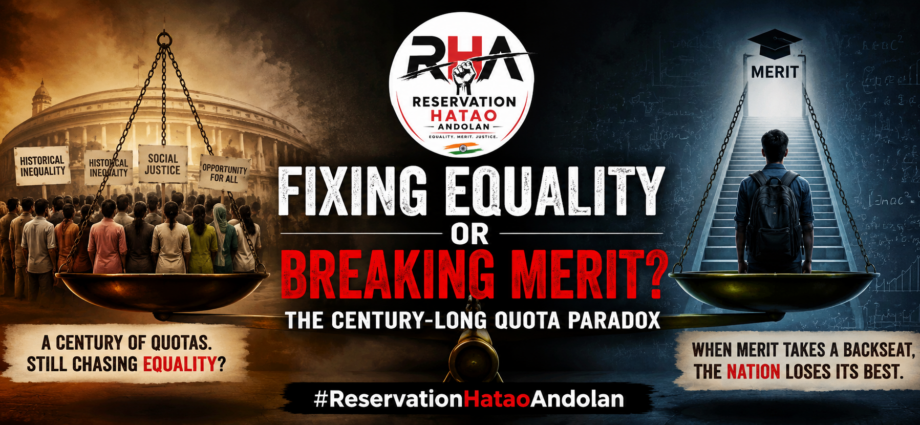
When NEET aspirant Harsh Dubey stepped onto prime-time media channels and later into the protests at Jantar Mantar, he didn’t just critique an exam leak—he shattered the mainstream silence surrounding the modern quota debate. By openly challenging why student movements completely sidestepped the crushing realities faced by unreserved aspirants, his unfiltered arguments went viral, catapulting the Reservation Hatao Andolan from digital chatrooms straight into the center of national news.
Taking his grassroots advocacy a step further, Dubey made headlines by carrying the Constitution directly to the Supreme Court. Engaging in high-level discussions with senior and junior legal experts at the Supreme Court Media Park, he sought to unpack the core mechanics of constitutional reform. The dialogue focused heavily on legal frameworks—exploring how Articles 15, 16, and 368 function, whether a parliamentary route or judicial review could ever realistically address structural reservation changes, and how to balance demands for absolute social equity with the burning grievances of general-category youth.
This bold pivot—from shouting slogans on the streets to consulting constitutional experts at the nation’s highest judicial institution—transformed Dubey from a viral internet phenomenon into a focal point for a broader, highly polarized national movement. It forced mainstream anchors, legal scholars, and political establishments to confront an uncomfortable question: How can Indian democracy reconcile historical social justice with the modern aspirations of an intensely competitive youth demographic?
An Open Call to Ajeet Bharti & Digital Voices – Time to Join Hands with Harsh Dubey
Team Humaari Baat strongly calls upon prominent digital commentators like Ajeet Bharti and online content creators driving the anti-reservation discourse on X and other platforms to join hands with on-ground activist Harsh Dubey. While digital campaigns and analytical commentary have successfully shattered mainstream silence and awakened millions of unrepresented youth, virtual outrage alone cannot rewrite national policy. To transform scattered digital momentum into structural, constitutional reform, online influence must merge seamlessly with the fierce, ground-level courage of leaders like Dubey, who has carried the fight directly to television screens and the Supreme Court. Unifying these virtual and physical fronts prevents the movement from fracturing into isolated echo chambers and builds a formidable, cohesive force. As Team Humaari Baat maintains, protests and tweets are merely the sparks; the ultimate battle must transition from hashtags to the halls of Parliament through a dedicated political alternative. By uniting digital strategists and ground warriors into a single, cohesive Dharmik Yuddha, this movement can bridge the gap between online awareness and legislative action, paving the way for true merit, equity, and lasting national reform.
Humaari Baat Prespective on Reservation Hatao Andolan
Team Humaari Baat firmly maintains that NEET aspirant Harsh Dubey has ignited a powerful and righteous Dharma Yuddha against systemic inequality, and we stand shoulder-to-shoulder with him as long as his path remains grounded in Dharma. However, we firmly believe that temporary street protests and viral media outbursts are merely the sparks, not the ultimate destination for permanent change. While raising awareness breaks decades of mainstream silence, true equity cannot be achieved solely through digital campaigns or studio debates. To secure a fair future based on merit and genuine reform, the movement must transition from agitation to legislation by entering the ultimate platform where laws are actually shaped—the Parliament of India. Protests can draw the nation’s attention, but meaningful national policy requires structural political representation. Therefore, we strongly encourage Dubey and his supporters to evolve this grassroots momentum into a dedicated political alternative. By stepping directly into the legislative arena, they can legally address structural anomalies and bring true balance back to the system. Team Humaari Baat pledges its unwavering support for every genuine Dharmik effort aimed at building a fairer, merit-driven nation, provided the struggle moves forward with clear vision, absolute integrity, and a concrete pathway to parliamentary power.