





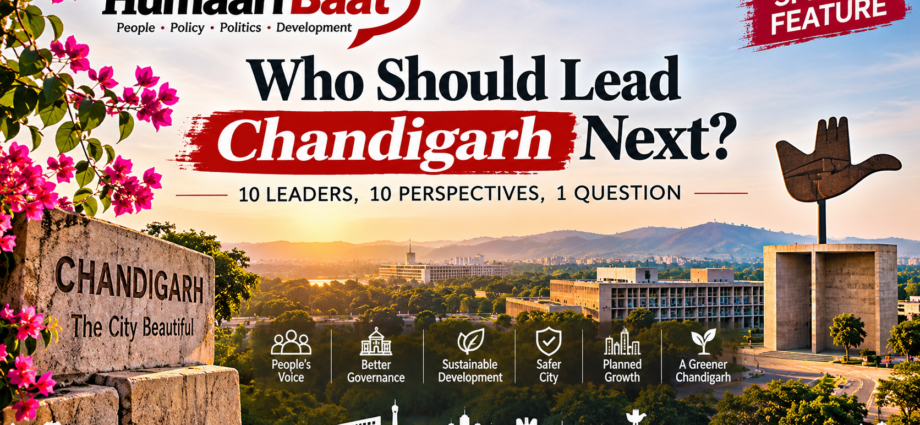
Chandigarh is widely recognised as one of India’s cleanest and greenest urban centres. Designed by renowned architect Le Corbusier, the first planned city of independent India earned its iconic identity as ‘The City Beautiful’ through its distinctive urban planning, organised sectors, green belts, wide roads and architectural character.
However, the city is now facing a new set of challenges that demand serious political attention.
Over the years, Chandigarh has evolved beyond its original boundaries to become the centre of a rapidly expanding regional urban ecosystem. Its proximity and seamless connectivity with Panchkula, Mohali, Zirakpur, Kharar and other neighbouring towns have made it a major destination for employment, education, healthcare, shopping and recreation.People from Punjab, Haryana, Himachal Pradesh, Uttar Pradesh, Bihar and Uttarakhand travel to Chandigarh for better opportunities, while thousands visit the city during weekends, festivals and holidays.This growing regional mobility is a natural consequence of Chandigarh’s economic and educational importance. However, it also places increasing pressure on the city’s existing infrastructure, public transport, roads, parking facilities, water supply, sanitation and civic administration.Chandigarh’s own Master Plan 2031 acknowledges that the city serves a wider regional population, with floating populations and daytime visitors placing additional demands on infrastructure and public services.
Public safety is another major concern that deserves urgent attention. Crimes against women, sexual offences involving minors, murders, robberies, thefts and chain-snatching incidents have become important subjects of public debate.
The NCRB’s 2024 figures, reported in May 2026, recorded 96 rape cases in Chandigarh and 452 cases of crimes against women. These figures underline the importance of stronger preventive policing, safer public spaces, effective investigations and victim support systems.
As per the Sources
The challenge is not to compare Chandigarh with another metropolitan city through stereotypes, but to ensure that its urban development never comes at the cost of citizens’ safety and quality of life.
Although Chandigarh is classified as a Tier-2 city in many economic and commercial contexts, its responsibilities increasingly resemble those of a major metropolitan centre. It attracts students, professionals, entrepreneurs, tourists and investors from across North India. Its aspirations are no longer limited to maintaining its existing reputation; the city must prepare for its next phase of growth.
This brings us to a fundamental question: Does Chandigarh need a stronger and more accountable political leadership structure?
Unlike many major Indian cities, Chandigarh is a Union Territory without its own Legislative Assembly. Its administration operates under the Union Government, with an Administrator and an elected Municipal Corporation handling different aspects of governance.
It is therefore worth having a serious public discussion about greater democratic representation, stronger local decision-making and whether an appropriate legislative framework could help Chandigarh address its growing urban challenges. The city needs leaders who can understand its unique identity while preparing it for the future. Leadership must focus on public safety, sustainable urban planning, employment generation, modern infrastructure, affordable housing, education, healthcare, environmental conservation and transparent governance.It is time to look beyond political slogans and personalities.
We explore ten political leaders associated with Chandigarh, examining their public records, political experience, development-related positions and stated vision for the city’s future.
Because Chandigarh deserves leadership that understands not just what the city is today, but what it needs to become tomorrow.
Chandigarh Needs Its Own Legislative Assembly
Chandigarh’s growing urban challenges also raise an important question about its governance structure. Currently, the city operates under two major administrative institutions: the Chandigarh Administration, headed by the Administrator, and the elected Municipal Corporation (MC). While both have their respective responsibilities, citizens often encounter difficulties when an issue involves multiple departments or authorities. Whether it is persistent road blockages in residential sectors, excessive noise from nearby clubs, illegal parking, sanitation problems or other civic concerns, residents sometimes struggle to obtain permanent solutions. Responsibility can become fragmented, leaving citizens uncertain about which authority should be held accountable.
The Member of Parliament representing Chandigarh can raise these concerns in Parliament, but does not exercise direct executive control over the Chandigarh Administrator. This brings us to an important question: Does Chandigarh need its own Legislative Assembly? Unlike Delhi, which has a special constitutional arrangement under Article 239AA and an elected Legislative Assembly headed by a Chief Minister, Chandigarh remains a Union Territory without its own legislature. Chandigarh also has a distinctive social identity. As the shared capital of Punjab and Haryana and a major urban destination for neighbouring states, it represents a diverse mix of Punjabi, Haryanvi, Himachali, Kumaoni, Garhwali, Bihari, Uttar Pradesh and other communities.
This multicultural character makes inclusive and locally accountable governance particularly important.
A Legislative Assembly could provide a stronger platform for elected representatives to debate Chandigarh-specific concerns, formulate local policies and hold the executive accountable for development and public welfare, subject to an appropriate constitutional framework.
10. Advocate Satya Pal Jain – The Veteran Constitutional Lawyer
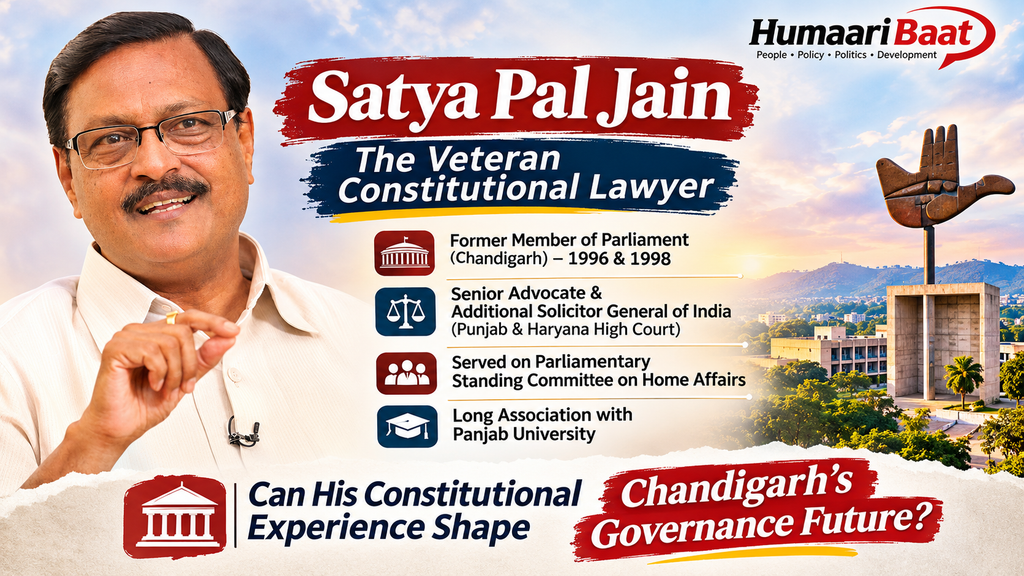
A veteran political figure from Chandigarh, Advocate Satya Pal Jain brings decades of experience in parliamentary politics, constitutional law and public life. A senior advocate and former Member of Parliament, Jain was elected to the Lok Sabha from Chandigarh in 1996 and 1998. During his parliamentary tenure, he served on committees including the Parliamentary Standing Committee on Home Affairs. India Press+1
His legal career has been equally prominent. He was appointed the first Additional Solicitor General of India for the Punjab and Haryana High Court at Chandigarh in April 2015. In September 2026, he received his sixth appointment to the position, extending his tenure until December 31, 2026. He also oversees Central Government litigation in the district and subordinate courts of Punjab, Haryana and Chandigarh. The Tribune+1
Jain has also maintained a longstanding association with Panjab University, serving in its Senate for several decades, and has been involved in the BJP’s national legal affairs.
Why his name features in this discussion
His experience in constitutional law, parliamentary affairs and the functioning of government institutions makes his public perspective relevant to Chandigarh’s governance debate. As Chandigarh discusses questions of greater democratic representation, administrative accountability, urban development and institutional reform, his views on the city’s constitutional future would be particularly relevant. The question for Chandigarh is whether its experienced political and legal leadership can help shape a governance framework that responds more directly to the aspirations of its residents.
9. Pawan Kumar Bansal – The Former Veteran Parliamentary Leader
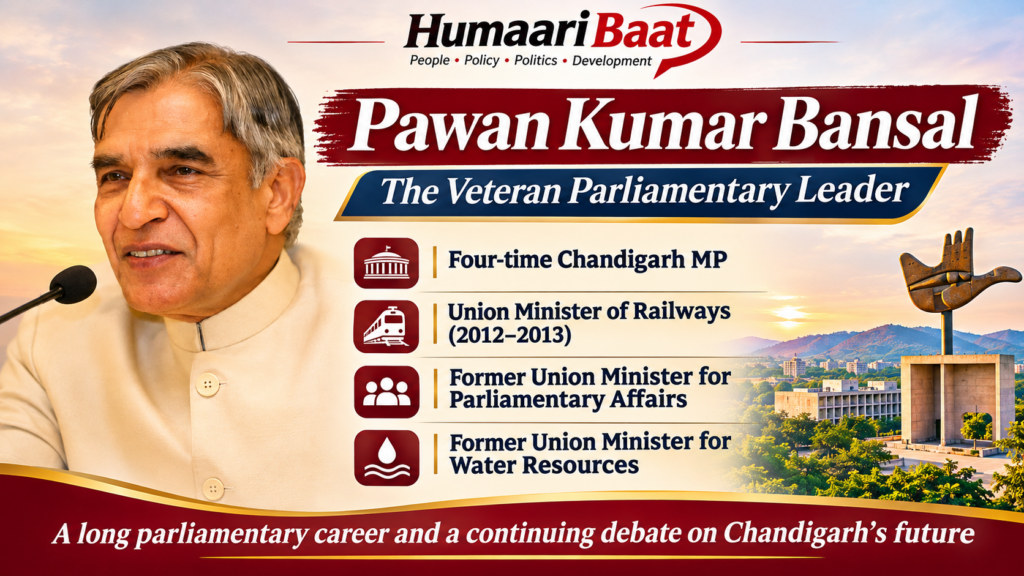
Pawan Kumar Bansal is among the most prominent and experienced political personalities associated with Chandigarh. A senior Indian National Congress leader, advocate and former Union Cabinet Minister, he has spent decades in parliamentary politics and public service.
Political Journey and Experience
Bansal began his political journey through the Congress organisation in Chandigarh and Punjab. He entered Parliament in 1984 as a Rajya Sabha member before establishing himself in Chandigarh’s electoral politics. He represented Chandigarh in the Lok Sabha four times, winning elections in 1991, 1999, 2004 and 2009.
His ministerial career included several important portfolios in the UPA government:
- Union Minister of Railways (2012–2013): Led the Railway Ministry and presented the Railway Budget in 2013.
- Union Minister of Parliamentary Affairs (2009–2012): Handled parliamentary coordination and legislative business.
- Union Minister of Water Resources: Worked on national water-resource administration.
- Minister of State for Finance: Handled responsibilities relating to expenditure, banking and insurance.
- Minister of State for Parliamentary Affairs.
His experience also extends to parliamentary committees, financial administration and national-level political organisation.
Chandigarh and the Question of Civic Autonomy
One of the important aspects of Bansal’s political engagement has been his involvement in Chandigarh’s administrative and municipal affairs. He has publicly raised concerns about the functioning and autonomy of the Municipal Corporation, including the distribution of responsibilities between the MC and Chandigarh Administration. His position on municipal decentralisation is particularly relevant to the ongoing debate about strengthening local democratic institutions.
Why His Name Features in This Discussion
Bansal’s long parliamentary career and experience in the Union Cabinet give him a substantial background in national governance. His association with Chandigarh over several decades also makes his perspective relevant to discussions about the city’s future. As Chandigarh faces growing urban pressures involving infrastructure, housing, traffic management, public safety and administrative accountability, his experience in government and Parliament provides an important reference point. His views on strengthening municipal governance and Chandigarh’s administrative autonomy are especially relevant to the broader discussion about whether the city needs its own Legislative Assembly. The larger question is how Chandigarh’s established political leadership can translate decades of parliamentary experience into solutions for the city’s emerging challenges.
8. Vivek Atray – The Administrator with a Vision for Innovation
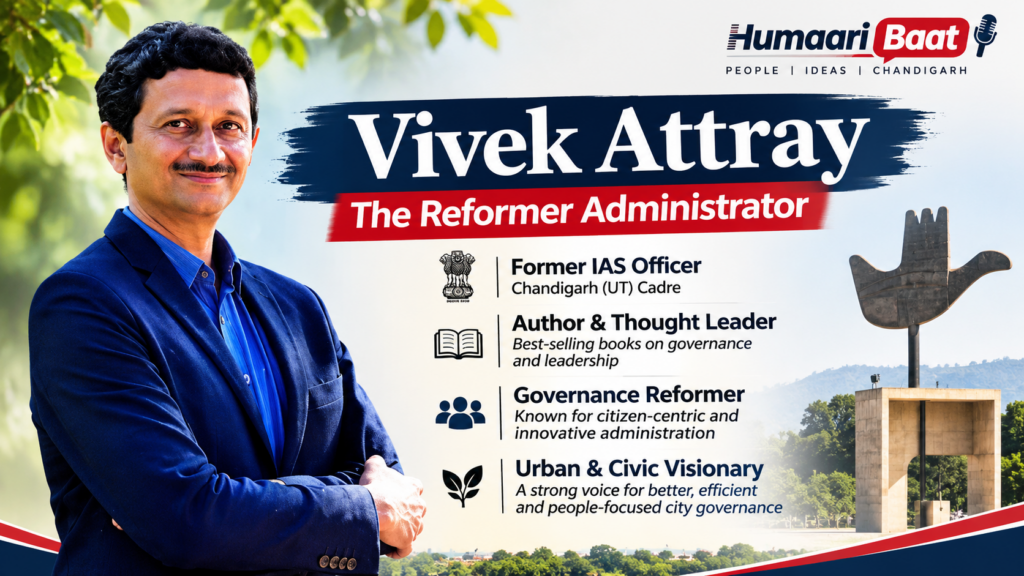
Vivek Atray represents a different dimension of public leadership in Chandigarh. A former IAS officer, author, motivational speaker and governance mentor, he brings administrative experience, institutional understanding and a strong association with the city’s development journey.
Unlike conventional political personalities, Atray’s professional background is rooted in public administration, innovation, education and communication.
Administrative Experience and Contributions
During his tenure in the Haryana cadre, Atray held several important administrative assignments, including:
- Director, Information Technology, Chandigarh: Associated with the development of Chandigarh’s IT ecosystem and IT Park.
- Director, Tourism, Chandigarh: Worked towards promoting Chandigarh as a tourism destination.
- Director, Public Relations: Handled government communication and media relations.
- Deputy Commissioner, Panchkula: Gained experience in district administration and public service delivery.
- Director, Secondary Education, Haryana: Worked in the education administration sector.
One of the notable initiatives associated with his administrative career was the e-SAMPARK project, which brought government services closer to citizens through technology.
Beyond Civil Services
After voluntarily leaving the IAS in 2017, Atray developed a professional identity as an author, columnist, motivational speaker and leadership mentor. He founded SUVICHAR Think Tank and has been associated with the Chandigarh Literary Society, Public Relations Council of India and heritage-related initiatives. His work frequently addresses governance, leadership, education, entrepreneurship, emotional intelligence and institutional development.
He has also served on the Governor’s Advisory Council for Chandigarh.
Why His Name Features in This Discussion
- Chandigarh’s future challenges require discussions that extend beyond conventional political administration.
- The city needs to explore innovative approaches to urban management, technology-driven public services, education, tourism, entrepreneurship and institutional efficiency.
- Atray’s experience in Chandigarh’s IT development, e-governance initiatives and public administration provides an interesting perspective on these subjects.
- His background also raises an important question for Chandigarh’s political future: can experienced administrators, policy thinkers and professionals bring fresh ideas into democratic leadership?
As Chandigarh looks towards its next phase of development, Vivek Atray’s administrative experience and public-policy perspective make him a relevant personality in the conversation about the city’s future leadership.
7. Arun Sood – The Organisational Leader and Former Mayor
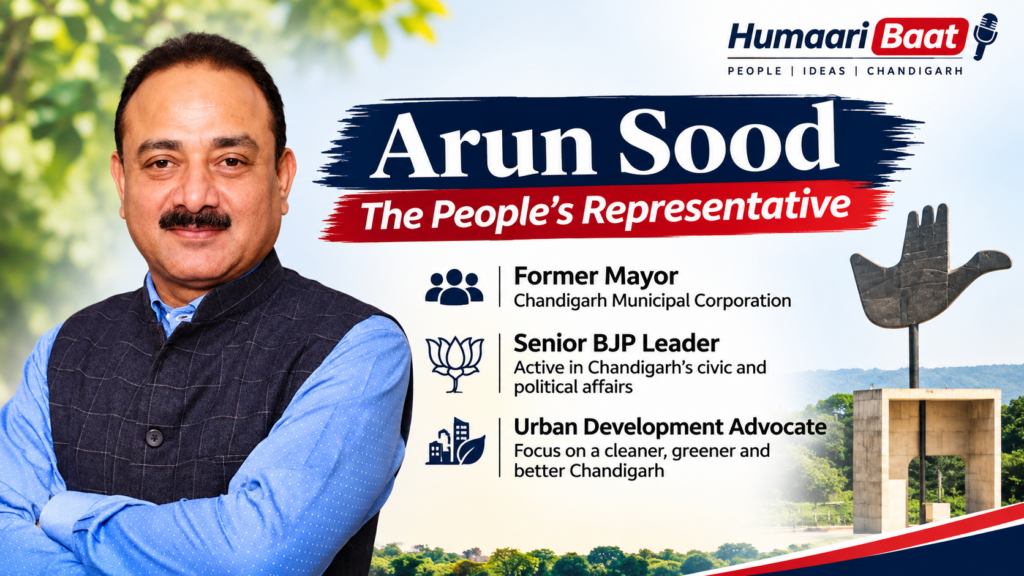
Arun Sood is a prominent BJP leader associated with Chandigarh’s municipal politics and organisational affairs. An advocate by profession, he has held several important positions within the Bharatiya Janata Party and the Chandigarh Municipal Corporation.
His political journey includes student politics, organisational responsibilities and elected municipal leadership.
Political Journey and Experience
Sood’s association with public and political organisations began through the RSS and Akhil Bharatiya Vidyarthi Parishad (ABVP). He subsequently held responsibilities in the BJP’s youth wing before becoming actively involved in Chandigarh politics.
His major political milestones include:
- Mayor of Chandigarh (2016): Served as the city’s Mayor and headed the Municipal Corporation.
- Municipal Councillor: Represented a Chandigarh municipal ward and participated in civic administration.
- President, Chandigarh BJP (2020): Took charge of the party’s city unit, succeeding Sanjay Tandon.
- BJP Organisational Leadership: Held various responsibilities within the party at the state and city levels.
His Approach to Chandigarh’s Civic Governance
During his mayoral tenure, Sood spoke about improving coordination between the Municipal Corporation and Chandigarh Administration, streamlining civic functioning and strengthening sanitation services. He also highlighted traffic congestion, particularly around Tribune Chowk, as an important urban infrastructure concern. In his public statements as Chandigarh BJP president, he emphasised the need for stronger participation of elected representatives in administrative decision-making, arguing that people’s representatives understand local requirements through their direct interaction with residents.
Why His Name Features in This Discussion
- Chandigarh’s governance debate involves more than infrastructure development. It also concerns the relationship between elected representatives and administrative authorities.
- Sood’s experience as Mayor, councillor and Chandigarh BJP president gives him direct exposure to the city’s municipal governance structure.
- His views on administrative coordination, civic accountability, traffic management and the role of elected representatives are relevant to the ongoing discussion about Chandigarh’s political future.
As the city considers stronger democratic representation and the possibility of its own Legislative Assembly, Arun Sood’s experience in municipal politics makes his perspective relevant to the debate.
6. Gul Panag – The Urban Voice with a Social Outlook
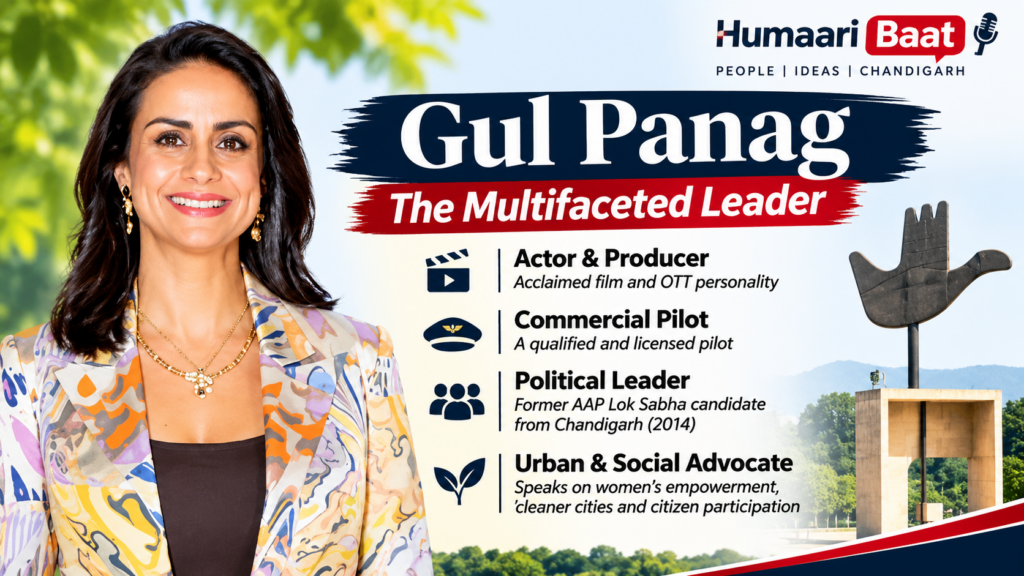
Gul Panag, born Gulkirat Kaur Panag, is a Chandigarh-born actor, entrepreneur, social activist and former political candidate. She represents a different kind of public personality in Chandigarh’s political landscape, combining professional achievements, social engagement and an earlier electoral entry.
Political Journey and Chandigarh Connection
In March 2014, Gul Panag joined the Aam Aadmi Party and contested the Chandigarh Lok Sabha election.
Her candidature attracted considerable public attention, particularly because she was born and brought up in Chandigarh and had a personal connection with the city. Her grandfather had settled in Chandigarh in 1960. She secured 1,08,679 votes and finished third in the 2014 Lok Sabha election, which was won by BJP candidate Kirron Kher. Panag subsequently distanced herself from active AAP politics and resigned from the party in June 2021.
Beyond Electoral Politics
Gul Panag has built a multifaceted professional career:
- Acting and Cinema: Appeared in films including Dor, Manorama Six Feet Under and Turning 30.
- Entrepreneurship: Co-founded MobieFit, a health and fitness technology venture.
- Social Activism: Has participated in initiatives concerning gender equality, education and social development.
- Motorsports and Aviation: Known for her interest in motorcycling, motorsports and aviation.
- Public Engagement: Frequently discusses urban living, fitness, women’s safety and social issues.
She also founded the Colonel Shamsher Singh Foundation, associated with social-development initiatives.
Why Her Name Features in This Discussion
- Chandigarh needs an ongoing conversation about urban development, women’s safety, environmental sustainability, modern mobility and quality of life.
- Panag’s background in social activism, entrepreneurship and her previous electoral experience provides another perspective on these subjects.
- Her personal connection with Chandigarh also makes her an interesting figure in discussions about the city’s changing identity and future aspirations.
The larger question is whether professionals and public personalities with experience beyond conventional party politics can contribute meaningfully to Chandigarh’s democratic and urban-development discourse.
5. Bhupinder Singh Badheri – The Grassroots Political Veteran
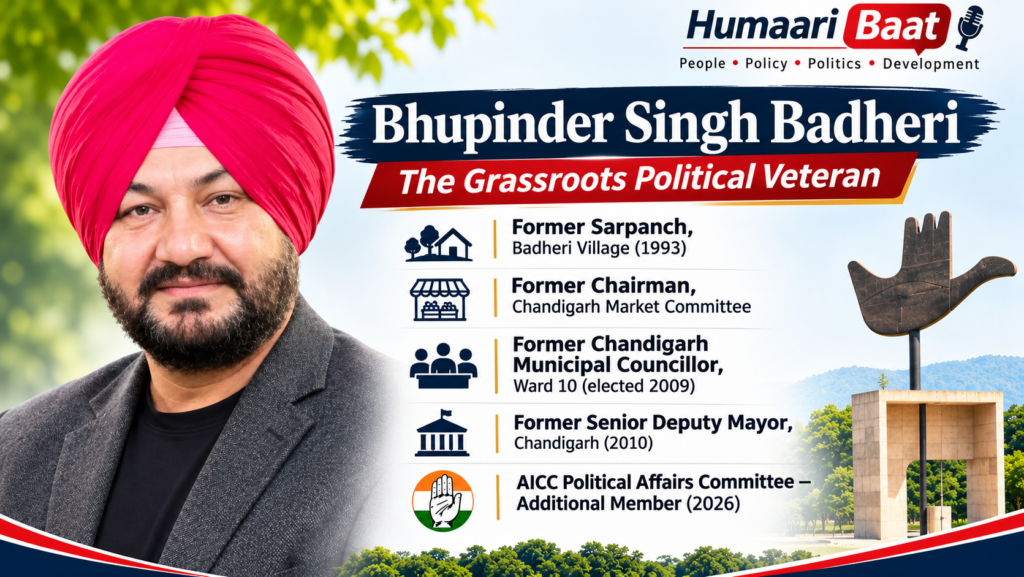
Bhupinder Singh Badheri is a veteran Congress politician with a longstanding association with Chandigarh’s grassroots politics. His political journey spans village-level leadership, municipal administration, cooperative institutions and party organisation.
Unlike leaders whose political careers have primarily revolved around national politics, Badheri’s experience has been closely connected with local governance and Chandigarh’s rural and urban communities.
Political Journey and Experience
Badheri has held several important public and organisational positions:
- Sarpanch, Badheri Village (1993): Began his elected public leadership at the village level.
- Chairman, Chandigarh Market Committee: Served in an important agricultural marketing institution.
- Chairman, Panchayat Samiti (2001): Gained experience in local and rural administration.
- Municipal Councillor (2009): Elected from Ward No. 10 on a Congress ticket.
- Senior Deputy Mayor, Chandigarh (2010): Served in the Municipal Corporation’s elected leadership.
- Chandigarh Pradesh Congress Committee: Held organisational responsibilities within the city Congress unit.
- AICC Political Affairs Committee (2026): Appointed an additional member of the committee in October 2026.
His Connection with Grassroots Governance
Badheri’s political background is particularly associated with Chandigarh’s villages and sectors on the city’s southern side. His experience as a sarpanch, Panchayat Samiti chairman and municipal councillor has exposed him to different layers of local administration.The concerns of Chandigarh’s villages, including civic infrastructure, roads, sanitation, land-related issues and public facilities, remain important subjects in the city’s development debate.
Why His Name Features in This Discussion
- Chandigarh’s future development requires attention not only to its prestigious sectors and commercial centres but also to its villages, peripheral communities and residential neighbourhoods.
- Badheri’s experience across village administration and the Municipal Corporation makes his perspective relevant to discussions about decentralised governance and public representation.
- His recent appointment to the AICC Political Affairs Committee also reflects his continued involvement in Congress’s organisational affairs.
As Chandigarh debates stronger democratic representation and greater administrative accountability, Badheri’s grassroots political experience provides another perspective on how local leadership can address the city’s evolving civic needs.
4. Kuldeep Kumar Dhalor (Tita) – The Grassroots Leader of Chandigarh
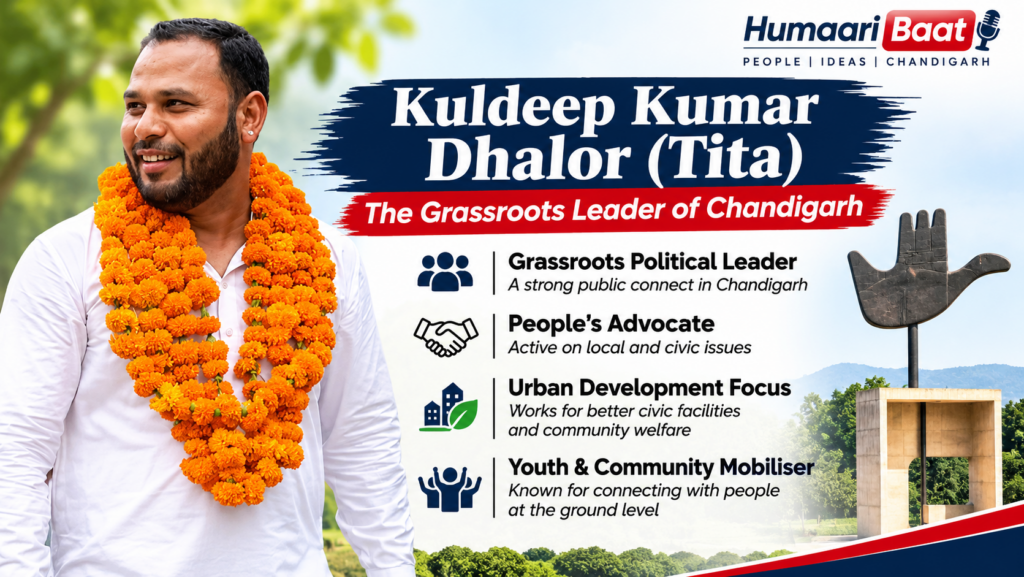
Kuldeep Kumar, popularly known as Kuldeep Tita, brings a grassroots dimension to Chandigarh’s political landscape. His journey from working in the sanitation sector to becoming the Mayor of Chandigarh is one of the distinctive stories in the city’s municipal politics. A former councillor from Dadumajra, Kumar became a prominent AAP face through his association with neighbourhood-level civic issues, particularly sanitation and waste management.
Political Journey and Experience
- Municipal Councillor (2021): Elected from Ward 26, representing the Dadumajra area.
- Mayor of Chandigarh (2024–2025): Served as Mayor after the Supreme Court overturned the original mayoral election result and declared him the winner.
- AAP Municipal Leadership: Became one of the party’s prominent representatives in Chandigarh’s civic politics.
- Grassroots Background: His earlier work in the sanitation sector gave him a direct connection with municipal services and ground-level civic concerns.
The Landmark Mayoral Election
His mayoral election in February 2024 attracted national attention. After the original election result was challenged, the Supreme Court examined the ballot papers and declared Kuldeep Kumar the winner. The case became an important episode in India’s electoral and constitutional history, highlighting the significance of transparency and integrity in democratic processes.
Dadumajra and Chandigarh’s Environmental Challenge
The Dadumajra dumping ground remains one of Chandigarh’s most persistent environmental and civic concerns. Kumar has repeatedly raised the issue of legacy waste, foul smell, pollution and the difficulties faced by residents living around the dumping ground. In April and August 2026, he joined other AAP leaders in demanding an independent investigation into expenditure on waste clearance and the continuing presence of legacy waste at the site. This issue connects directly with Chandigarh’s ambition to maintain its identity as the City Beautiful.
Why His Name Features in This Discussion
- Kumar’s political journey offers a perspective rooted in neighbourhood representation, municipal services and environmental concerns.
- His experience as a former Mayor and councillor makes his public record relevant to discussions about municipal accountability, sanitation infrastructure, waste management and the relationship between elected representatives and the Chandigarh Administration.
As Chandigarh debates its future governance structure, the experience of leaders who have worked directly with its civic institutions deserves examination.
3. Harmohinder Singh Lucky – The Grassroots Congress Leader
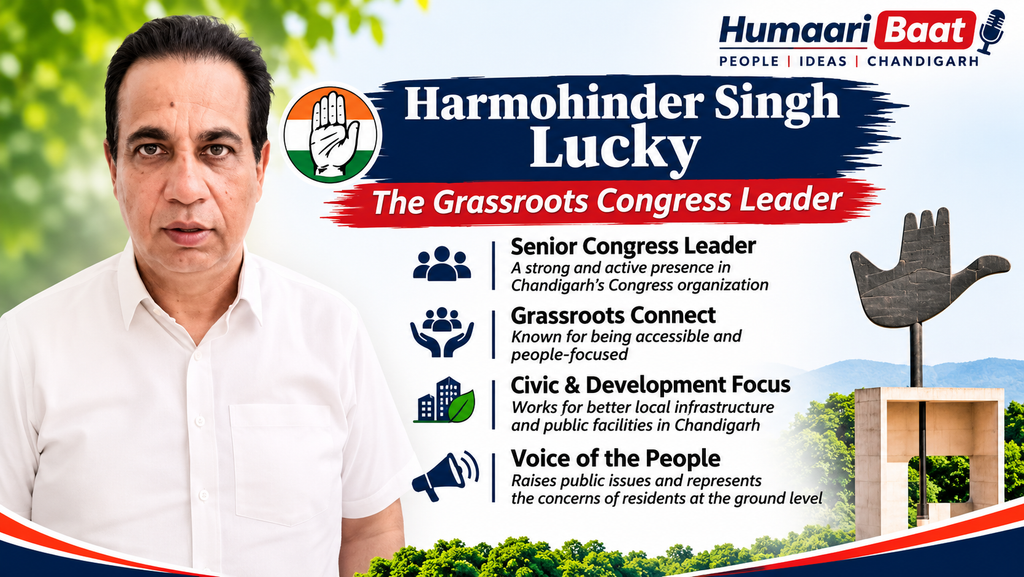
Harmohinder Singh Lucky is a recognised face of Chandigarh’s Congress politics, associated with grassroots organisation, municipal affairs and local political engagement. His political career reflects the role of party organisations and elected civic representatives in addressing the concerns of Chandigarh’s residents.
Political Journey and Experience
An advocate by profession, Harmohinder Singh Lucky began his political career as a student leader at DAV College, Chandigarh. His involvement in student politics laid the foundation for a career spanning youth leadership, municipal administration and party organisation.
His major political responsibilities include:
- President, Chandigarh Territorial Congress Committee (since 2022): Leading the party’s city organisation and coordinating its political activities.
- Deputy Mayor of Chandigarh (2006): Served in municipal leadership and gained experience in local civic administration.
- Municipal Councillor: Represented a ward comprising Sectors 20 and 33.
- President, Chandigarh Youth Congress: Held leadership responsibilities within the party’s youth organisation.
- President, Chandigarh NSUI: Participated in student political leadership.
- Member, Panjab University Senate and Syndicate: Served two terms in university governance bodies.
- District Congress President: Held organisational responsibilities at the district level.
His Role in Chandigarh’s Political Landscape
- Since becoming Chandigarh Congress president in June 2022, Lucky has been involved in party organisation, electoral preparations and public outreach.
- He played an organisational role during the 2024 Lok Sabha election, when Congress candidate Manish Tewari won the Chandigarh parliamentary seat.
- Lucky has also participated in public meetings addressing local concerns and in discussions surrounding the functioning of the Municipal Corporation.
- In December 2025, he announced that Congress was preparing to contest the 2026 Chandigarh Municipal Corporation elections independently.
- Beyond party politics, Lucky was named chairman of the Art, Culture, Tourism and Heritage Preservation Standing Committee of the Chandigarh Administrator’s Advisory Council in December 2025.
Chandigarh’s Cultural Identity and Civic Challenges
Chandigarh’s multicultural population, expanding urban boundaries and growing regional importance create complex governance questions. Lucky’s involvement in municipal politics and the Administrator’s Advisory Council connects his public responsibilities with several of these issues. His association with the committee on art, culture, tourism and heritage preservation is particularly relevant to Chandigarh’s architectural identity, cultural diversity and tourism development.
Why His Name Features in This Discussion
- Harmohinder Singh Lucky’s political background combines student leadership, municipal experience, university governance and party organisation.
- His previous role as Deputy Mayor provides a connection to the practical functioning of Chandigarh’s civic institutions, while his responsibilities as Congress president place him within the city’s broader political debates.
- As Chandigarh considers stronger democratic representation, administrative accountability and the possibility of its own Legislative Assembly, his publicly documented political experience provides a basis for examining his positions on these issues.
For Chandigarh’s future, the central question is how grassroots political engagement can be translated into effective civic administration, transparent decision-making and lasting solutions to residents’ concerns.
2. Sanjay Tandon – The Organisational Leader with a Development Agenda
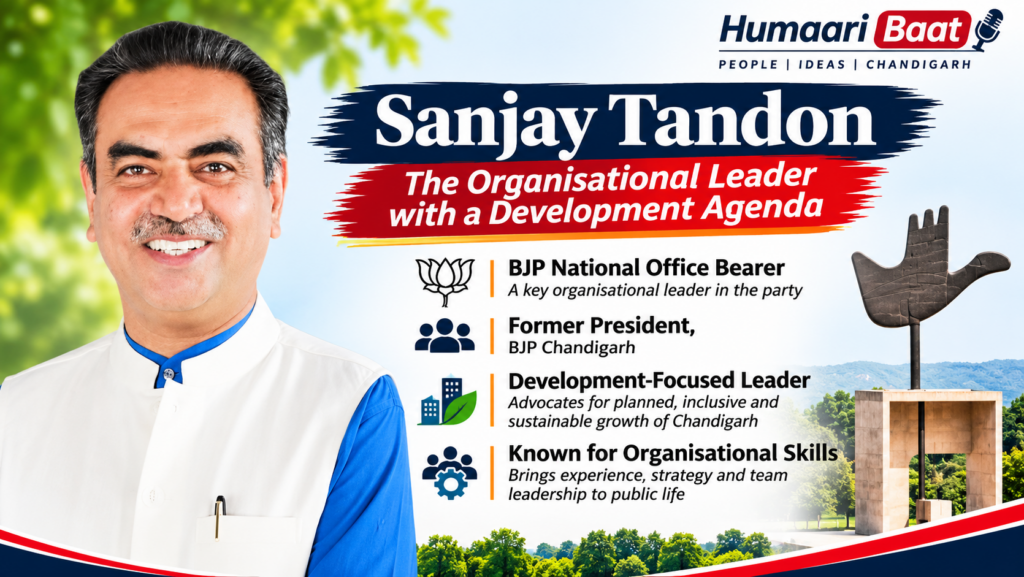
Sanjay Tandon is a prominent BJP leader with a longstanding association with Chandigarh’s political, social and institutional landscape. Having spent much of his life in the city, he has developed an extensive organisational presence through party leadership, social initiatives, sports administration and public engagement.
A Chartered Accountant by profession, Tandon is the son of former Chhattisgarh Governor and senior BJP leader Balramji Dass Tandon.
Political Journey and Experience
Some of his notable responsibilities include:
- President, Chandigarh BJP (2010–2019): Led the party’s city organisation for nearly a decade.
- Member, BJP National Council: Continues to hold a national-level organisational position.
- BJP Co-Incharge, Himachal Pradesh: Has handled organisational responsibilities outside Chandigarh.
- BJP Lok Sabha Candidate (2024): Contested the Chandigarh parliamentary election against Congress candidate Manish Tewari.
- Member, UT Administrator’s Advisory Council: Associated with Chandigarh’s advisory and policy-related institutional framework.
- President, UT Cricket Association: Involved in sports administration and development.
Focus on Chandigarh’s Development
Tandon has publicly raised several issues concerning Chandigarh’s residents and urban administration.
His recent interventions have included:
- Property Ownership: Advocating freehold ownership rights for residents holding properties under General Power of Attorney arrangements.
- Chandigarh Housing Board: Supporting need-based changes in residential properties to accommodate evolving family requirements.
- Education: Raising concerns about service conditions, pension benefits and pay parity for teachers in government-aided institutions.
- Sports Infrastructure: Advocating better utilisation of school playgrounds and improved sporting facilities.
- Municipal Governance: Proposing reforms to the mayoral tenure system to improve administrative continuity and representation.
- Civic Employees: Taking up service-related concerns of Municipal Corporation employees with the administration.
Why His Name Features in This Discussion
- Chandigarh’s future requires a political leadership structure that can bridge the gap between residents, elected representatives and the administration.
- Tandon’s long experience in city-level party organisation, his institutional associations and his engagement with property, education, sports and municipal issues provide several dimensions for examining his public role.
- His involvement in Chandigarh’s governance debates also makes his views relevant to the discussion about strengthening democratic representation and giving the city a more accountable political structure.
The larger question is how his organisational experience and engagement with the Chandigarh Administration could translate into measurable improvements in the city’s governance and quality of life.
1. Retd. Colonel Rajeev Bagga – The Soldier’s Spirit, Nation First
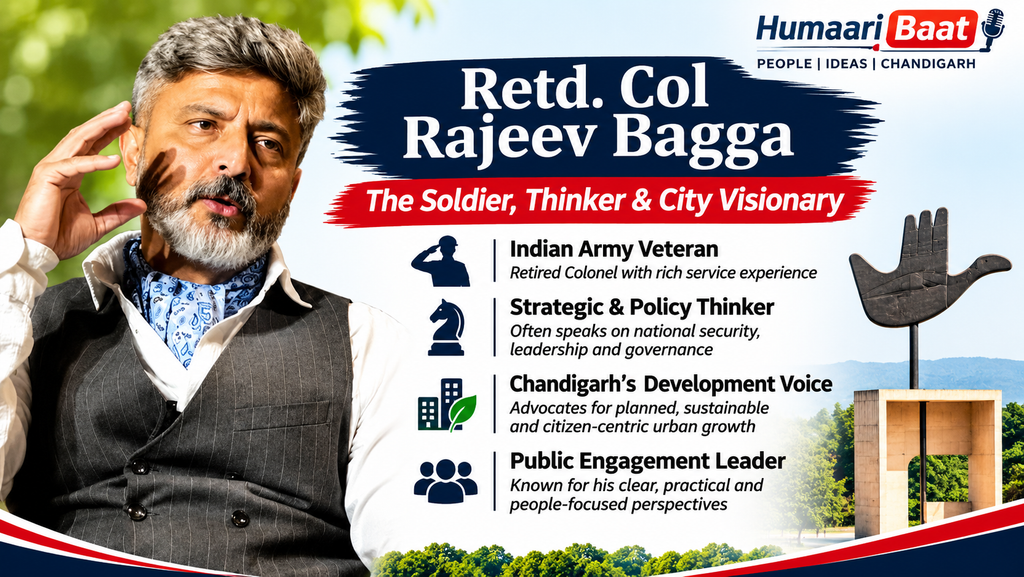
There is a fundamental difference between seeking political power and dedicating one’s life to a larger national purpose. Retired Lieutenant Colonel Rajeev Bagga represents a leadership profile rooted in military discipline, national service, strategic thinking and the conviction that individual responsibility must come before personal ambition. With an extensive military career spanning approximately 32 years, Colonel Bagga’s professional journey has been associated with the Indian Army, the elite National Security Guard (NSG) and India’s national security establishment. In a city that carries the distinction of being India’s first planned city, his inclusion introduces a different dimension to the discussion about leadership: Can the discipline, strategic vision and sense of duty cultivated through military service find meaningful expression in civilian urban governance?
Military Service: A Life Shaped by Duty
Colonel Bagga’s military background forms the foundation of his public identity.
His professional journey includes:
- Indian Army: Approximately 32 years of military service, involving operational and leadership responsibilities.
- Indian Military Academy: Received professional military training at one of India’s most prestigious military institutions.
- National Security Guard: Associated with the elite Black Cat Commando force.
- Counter-Terrorism Experience: Served in operational environments, including Jammu and Kashmir.
- National Security Responsibilities: Gained exposure to strategic security, operational preparedness and institutional coordination.
Military service demands more than physical courage. It requires the ability to make difficult decisions under pressure, maintain institutional discipline, coordinate teams and remain accountable for the consequences of one’s decisions.
These are qualities that also deserve consideration in discussions about public administration.
Beyond the Uniform: Nation-Building Through Young India
A soldier’s contribution to the nation does not necessarily end with retirement. Colonel Bagga’s post-service engagements have included youth mentorship, leadership development, defence awareness and motivational speaking. His association with NCC cadets, defence aspirants and educational institutions reflects an interest in preparing young Indians for responsibility, discipline and public service.
His professional engagements have also involved:
- Leadership and personality-development sessions.
- Guidance for young people aspiring to join the armed forces.
- Awareness about national security and defence preparedness.
- Promoting physical fitness, resilience and mental preparedness.
- Sharing lessons from military leadership with civilian institutions.
Why Chandigarh Needs to Hear This Voice
Chandigarh is not merely an administrative headquarters or a commercial destination. It is a city built around an ambitious national vision.Its architecture, planned sectors, institutional establishments, educational centres and green spaces represent an aspiration for organised urban living.
Yet the city now faces complex challenges involving public safety, civic discipline, traffic congestion, environmental protection, urban expansion and administrative accountability. These challenges require more than routine political announcements. They require long-term planning, institutional coordination, transparent execution and a culture of responsibility. A military background does not automatically translate into expertise in municipal administration. However, experience in leadership, operational coordination, emergency preparedness and institutional accountability can contribute a valuable perspective to urban governance.
A Different Kind of Leadership Proposition
- Colonel Bagga’s inclusion represents an opportunity to examine a form of public leadership that originates outside conventional electoral politics.
- The central question is not whether a soldier should become a politician, but whether people with a demonstrated record of public service, national commitment and institutional leadership should be encouraged to participate in democratic discussions about the future of their cities.
- Chandigarh needs to preserve its identity while preparing for the demands of a new generation. It needs leadership that respects its heritage, understands its multicultural population and approaches public responsibility with seriousness.
- The uniform may be retired, but the larger question of service to the nation never retires.
If Chandigarh is to imagine a new chapter in its governance, voices from India’s defence and public-service institutions deserve a place in that conversation.
Conclusion: Chandigarh Deserves Leadership Beyond Political Promises
Chandigarh stands at an important crossroads. The city that was envisioned as a symbol of modern India must now prepare itself for a new generation of urban challenges. Its identity as the City Beautiful cannot be preserved through architecture and green spaces alone. It requires public safety, efficient administration, sustainable infrastructure, economic opportunities, environmental responsibility and a governance system that listens to its citizens. The ten personalities discussed in this article represent different dimensions of Chandigarh’s political and public life. From experienced parliamentarians and grassroots representatives to former administrators, social leaders and professionals from outside conventional politics, each brings a different background and perspective to the city’s future.
However, political experience should not be confused with public performance, nor should popularity be mistaken for administrative accountability.
Chandigarh needs leaders who can look beyond party affiliations, regional identities and electoral calculations. It needs a leadership culture that respects its multicultural character, protects its residents and understands that urban development is a continuous responsibility. The debate over a Legislative Assembly for Chandigarh also deserves serious consideration. Greater democratic representation, clearly defined administrative powers and direct accountability could form an important part of the city’s governance reforms. Ultimately, the future of Chandigarh should not be decided merely by political parties or individual ambitions. Its residents must have a meaningful voice in deciding the direction of their city.
The City Beautiful does not need another promise of transformation. It needs a vision, accountable leadership and the determination to deliver. Because Chandigarh belongs to its people, and its future must be shaped around their aspirations.