
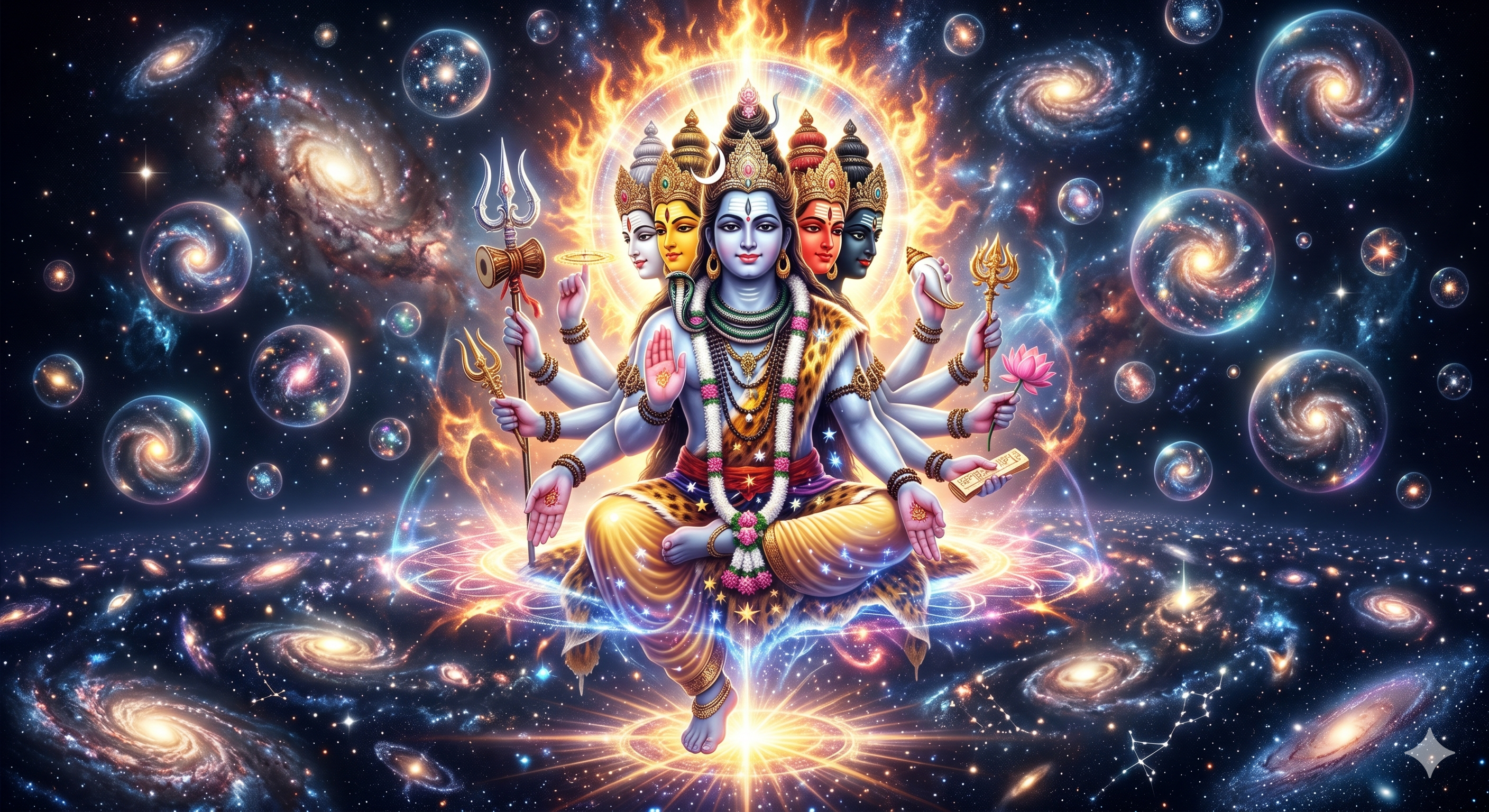







Who is Shiva? This is a question that often confuses people. In the various scriptures and eras of Sanatan Dharma, His form has been depicted from different perspectives. From the destroyer and benevolent ‘Rudra’ described in the Vedas, to the supreme, formless ‘Maha Sadashiv’ described in the Shiva Purana; whether it is ‘Mahesh’, the Trimurti form of creation, preservation, and destruction described in the Vishnu Purana, or the ‘Rudra’ born from Brahma’s eyebrow (wrath) during the expansion of creation—every form of Shiva holds infinite mysteries within itself.
Despite these diverse narratives, every follower of Sanatan Dharma has wholeheartedly embraced the devotion of Shiva since time immemorial. Shiva is not a person or a limited definition, but an infinite element (Tattva). Come, today we shall understand this grand form of Shiva, His various manifestations, and His true meaning in detail.
The word Shiva is made of three letters: Sh + I + V
- Sh means Shoonyata (Void/Nothingness)
- I means Ishwari Shakti (Divine Energy)
- V means Vastu (Matter/Element)
Let’s understand this: The object or element containing the divine consciousness embedded within the void (Shoonyata) is called Shivastu, Shiva, or Shiva Tattva. That in which this very divine consciousness existed always, exists now, and will remain in the future, is what we call Sadashiv.
On the other hand, Rudra is formed by the combination of two words: Raḥ + Ādrā. Ra is the seed mantra (Beej Mantra) of fire, and the halant (visarga) is used for air. When the vibration, meaning ‘Ādrā’, of the fire-imbued air, meaning ‘Raḥ’, takes place, it is called Rudra. In the Padma Purana, this Rudra has been depicted through crying. The letter Sh is the seed of the void (Shoonyata) and the word Va is the seed of matter (Vastu).
However, when we speak of Shiva beyond the universe, we call Him Sadashiv, but when we speak of Shiva beyond infinite millions of universes, we call Him Maha Sadashiv.
Here is the exact translation of your text into English, keeping the terms Atma and Chitta as you requested, and formatting it for clear readability:
The Origin of Creation, the Trimurti, and Their Consorts
The question will naturally arise in your mind: how did all of this originate? And who among these is part of the Trimurti? Who are the consorts (wives) of all these forms of Shiva, and what is their role?
Let us understand. Maha Sadashiv is the true form beyond all these infinite millions of universes. Combining with the Atma element and Chitta power, this very being is called the Sacchidananda Parabrahman. Full Paramkrishna represents the Atma element, and Adi Parashakti represents the Chitta power. Advaita परमात्मा (Non-dual Supreme Soul) is the name of this state of Parabrahman. Shaivas call this Maha Sadashiv, Vaishnavas call this Parameshwar Paramkrishna, Shaktas call this Adi Parashakti, and Sikhs call this Akal Purakh.
For the purpose of cosmic creation, the Supreme Reality establishes itself in the forms of Maha Sadashiv, Adi Parashakti, and Paramkrishna.
Manifestations According to Different Realms and Their Consorts:
- Nirvana Loka: Maha Sadashiv manifests in Nirvana Loka as Svayambhu Mahashiva, and His wife is Adya Kali.
- Manidvipa: Maha Sadashiv manifests in Manidvipa as Kameshwar.
- Goloka: In Goloka, the male form of Lalitambika and Adya Kali manifests as Krishna, and the female form of Kameshwar manifests as Radha Rani. That means Paramkrishna, who is the form of Atma, manifests in his qualified (Sagun) form from the essence of Lalitambika and Kalika (we will explain this in detail in the next topic).
- In Goloka, the five-faced Mahashiva manifests from the left side of Krishna in the form of Mahashambhu.
- From the right side of this very Krishna, Mahavishnu originates.
- Vishnu is born from the Raas of Radha and Krishna. When Radha places that Vishnu upon a vessel (Dhigra Patra) into the ocean of milk (Ksheer Sagar), Durga nurtures him through Yoganishra.
- The consort of Mahavishnu is Lakshmi of Goloka, and this Mahalakshmi originates from Durga.
- Mahashamshan: Mahashambhu resides in Mahashamshan in the form of Mahakal, where His consort is Mahakali (Yogamaya).
- Sadashiv: The consort of Sadashiv is Bhagavati Mahadurga, meaning Parashakti Ambika, who is also called Uma. Lalitambika manifests Herself in Goloka in the form of Durga through Her Bhuvaneshwari form. The Tamasic form of Durga is Mahakali.
The Origin of Universes and the Role of the Trimurti:
Infinite universes are born from Mahavishnu, and Vishnu sustains those universes. The highest realm of every universe is Vaikuntha, of which Vishnu is the sovereign Lord.
- Mahesh originates from the eyebrow of Vishnu.
- Brahma originates from the navel lotus of Vishnu.
- Rudra is born from Brahma. Rudra is also called Shankar, and His consort is Bhavani. This same Bhavani later incarnates as Sati and then in the form of Parvati.
Mahesh or Ishwar, who originate from Vishnu, are the destroyer Shiva and part of the Trimurti. The wife of this Maheshwar is Maheshani Mahamaya.
Conclusion: Understanding the Essence of Shiva
To truly grasp the grand canvas of Sanatan philosophy, we must understand that Shiva is not a singular entity limited by a single story, but a multi-layered cosmic truth. From the formless void to the physical universe, the journey of Shiva Tattva unfolds in beautiful stages:
- The Ultimate Reality (Maha Sadashiv): Beyond infinite millions of universes lies the non-dual Parabrahman—the perfect union of Atma and Chitta power. Whether called Maha Sadashiv, Paramkrishna, Adi Parashakti, or Akal Purakh, it is the same eternal truth from which all realms, divine couples, and cosmic energies emerge.
- The Cosmic Blueprint: Through the sacred alphabet Sh + I + V, we realize that Shiva is the literal fabric of existence. He is the infinite void (Shoonyata), activated by divine energy (Ishwari Shakti), manifesting as the material universe (Vastu). When this divine consciousness exists eternally through time, He is Sadashiv. When it vibrates as cosmic energy through fire and air, He is Rudra.