






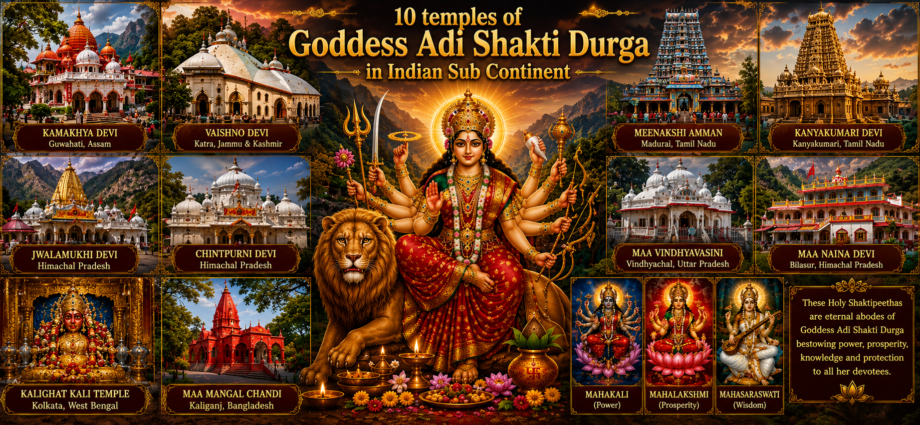
Sanatan Dharma or Eternal Dharma is the only religion in the world that revers divine feminine as supreme personality of God head. Often Identified with Para Brahman, Devi is cited as Supreme Power or Adi Parashakti. The Energy aspect that exists even before creation, during the creation and will last aft the dissolution of Universe. Bhagwati or Devi or Adi Shakti is the expression of universal energy that generates, preserves, and annihilates the entire universe. Shaktas, those who worship Devi as the ultimate reality, usually visit many temples dedicated to Bhagwati Durga too seek the fulfillment of their aspirations. Devi is not only central to Shaktas but is one of the most revered and beloved deities in all of Hinduism. Regardless of which deity is chosen as one’s Ishta-Deva, Hindus often regard Devi as the Universal Mother. To honor this, we are listing ten temples dedicated to the Mother Goddess, Durga.
Let’s bow down to the beloved son on Bhagwati, Ganpati Ganesha ji, Pawan Putra Shree Hanuman Ji and remember her Cosort and God of gods, Mahadeva and initiate the video. Confirming that all temples are equal in terms of divinity and holiness. We have positioned the temple based on secracy and their cultural impact.
10 – Jwala Ji temple in Kangra, Himachal Pradesh
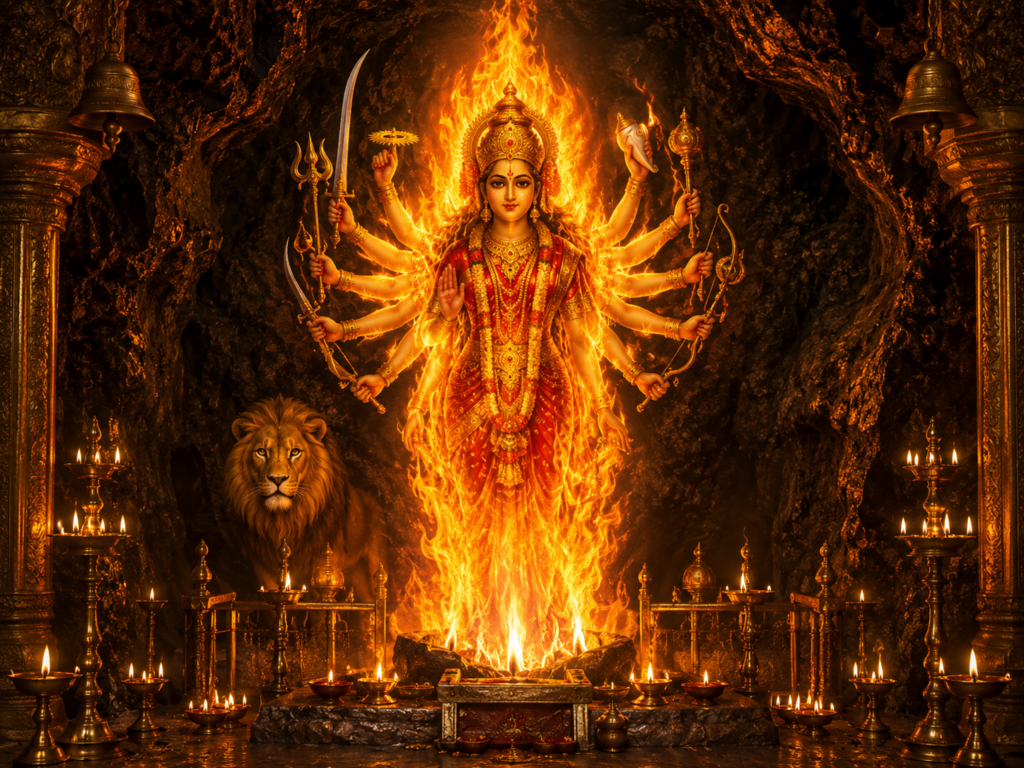
On Number 10 is Himachal Pradesh’s one of the oldest temples – Jawalaji Temple. This temple located in the Kangra district of Himachal Pradesh is one of the 52 Shaktipeeths and one of 18 Mahashakti Peethas. Actually, Goddess Sati was the first incarnation of Adi Shakti Durga. She incarnated as the daughter of Daksha. She was named Sati because of her 32 types of auspicious and pure attributes. By crossing her father’s wish, she married Lord Shiva. So Daksha organized a huge sacrifice and invited everyone except Shiva and Sati. So to complete the Yagna suspiciously, she went to the ceremony without permission. But Daksha with false ego insulted Lord Shiva. This made Goddess Sati furious, she jumped into the sacrificial fire and ended her life. Thereupon Shiva slew Daksha and carried Sati’s lifeless body to space. Vishnu with Sudarshana cut down Sati’s body into 108 parts. Out of 108 Shakti Peethas, 64 are known, 52 have bee accomplished and rest of the Shakti Peethas are in lost state. Where ever these body parts fell, the places later own became shakti peethas. As per scriptures and archeological evidence, here tongue of Sati maa fell. Along with tongue, the fire of yagna divided into nine parts which also fell to this place. This temple has temples established as Maa Jyoti. That is why it is called the Jwala Devi Temple. It is said that the burning in the temple has been burning for centuries. There is no need for any kind of oil or ghee to burn it. It keeps on burning naturally. It was asked here that every wish of the devotees is fulfilled. Along with the goddess, Shiva also manifested as Unmat Bhairav, while Devi manifested here as Ambika Devi.
As stated in Agam Granths of Nath Sampradaya, Here Bhagwati Ambika is waiting for Guru Gorakhnath Ji to let him feed meal of Khichadi, for this she made the kund water hot. Though hot fog comes out of it but if water is touched, it is felt cold. The place where Guru Gorakhnath’s Incense was placed is called Gorakh Dibi.
9. Amba Bai Temple, Kolhapur, Maharashtra
Located in Kolhapur, Maharashtra, the Ambabai Temple stands as a shrine of profound significance, particularly when viewed through a scientific lens. Crafted from a translucent, quadrangular stone, the temple’s west-facing idol possesses a unique characteristic that twice a year, the sun’s rays fall directly upon it becomes a reason for an event celebrated as ‘Kiranotsav’ (Festival of Rays). The presence of a Shivalinga atop Goddess Ambabai’s head clearly signifies that she is not merely a devoted wife or a handmaiden, but Ambika (the Supreme Mother)—the very foundation upon which Lord Mahadev rests. As is often stated that Durga represents the Shakti (power) of Shiva, her act of bearing the Shivalinga here illustrates the profound truth that, without Shakti, Shiva is but a lifeless corpse (Shava). This imagery underscores her Sattva quality and her absolute completeness, demonstrating that Jnana (Divine Knowledge)—embodied by Shiva—is entirely contained within her own being. Furthermore, the presence of Sheshanaga affirms her manifestation as Yogamaya and Mahanidra (the Great Cosmic Slumber). Sheshanaga symbolizes Kala (Time/Space); by bearing him upon her head, the Goddess declares that she transcends even the boundaries of space and death (Kala). The fundamental nature (Mula Prakriti) of Goddess Durga is Mahalakshmi; this very primal nature is also revered in its Saguna (manifest) form as the consort of Mahavishnu (Venkateswara).
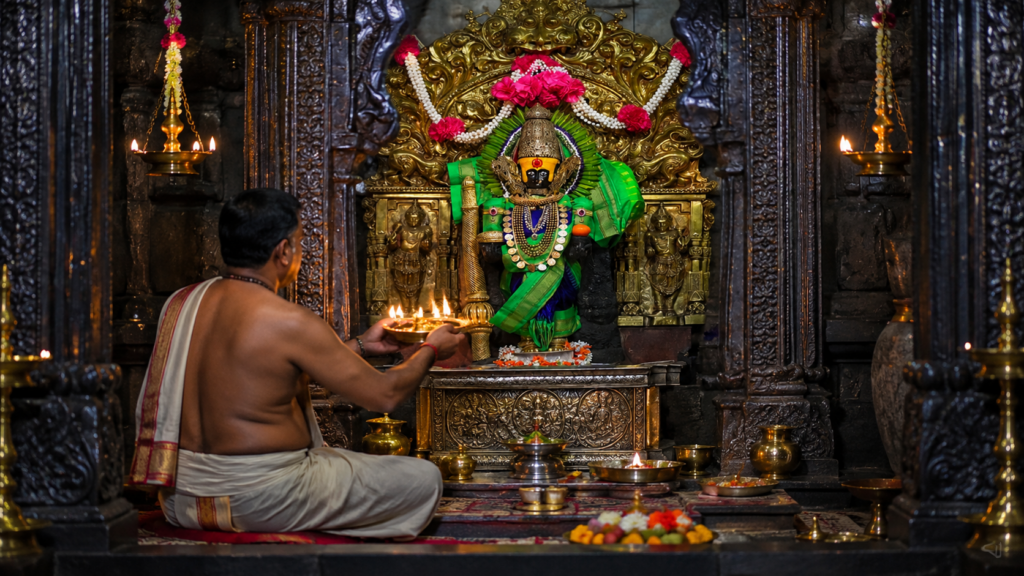
The ‘fundamental nature’ of Goddess Durga—the Mother of Ganapati—is Mahalakshmi, characterized by the Sattva quality. This implies that Mother Parvati, in the discharge of her domestic duties, embodies the attributes of her primal form—the four-armed Mahalakshmi; indeed, her eighteen-armed manifestation (Ashtadasha Swarupa) serves as irrefutable proof of her embodiment of the Trigunas (the three cosmic qualities). The four arms of the idol align with the principles of the Murti Rahasyam (the esoteric science of iconography), thereby revealing her essential nature. However, the presence of these specific symbols upon her head serves to encapsulate—in a compact, symbolic form—the immense power of her eighteen-armed manifestation as Mahamahalakshmi: wherein the Shivalinga represents Sattva (Knowledge), Sheshanaga represents Rajas (Action/Illusion), and the mace (Gada) held in her hand represents Tamas (Destruction). Thus, this idol fully validates your assertion that the Goddess is indeed one—assuming the nature of Mahalakshmi, Mahakali, or Mahasaraswati as the need arises to vanquish demons, yet in her primordial form, she manifests as ‘Amba’ to sustain the entire universe.
8. Nainadevi Temple – Nainital, Uttarakhand
Located in Nainital, Uttarakhand, the sacred shrine of Naina Devi stands as one of the most revered temples dedicated to the Divine Mother. Uttarakhand, often referred to as the “Land of the Gods,” is home to countless temples devoted to local and universal deities alike, and among them, Naina Devi Temple holds a unique spiritual significance. According to ancient belief, the eyes (Naina) of Goddess Sati fell near the beautiful Naini Lake, leading to the establishment of this holy shrine, from which the town of Nainital derives its name. The temple is also recognized as one of the sacred Shakti Peethas, symbolizing the eternal presence of Adi Shakti.
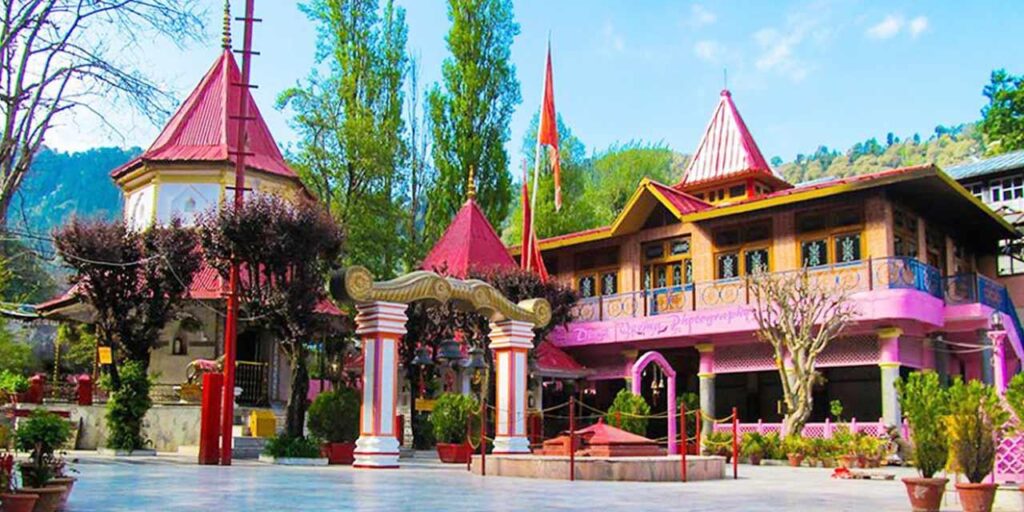
The architecture of the temple reflects deep devotion and spiritual symbolism. Within the sanctum, the Goddess is worshipped in the form of two divine eyes, representing Mother Naina Devi’s omnipresent vision and protective grace over her devotees. Throughout the year, pilgrims from across the country visit this sacred abode seeking blessings, peace, and fulfillment of their desires. However, during the auspicious festival of Navratri, the temple witnesses an extraordinary influx of devotees, with long queues stretching through the temple complex as thousands gather to seek the blessings of the Divine Mother.
The spiritual aura surrounding the temple has strengthened the belief that no devotee returns empty-handed from the abode of Maa Naina Devi. The shrine is regarded as a place where faith, devotion, and divine energy converge, granting solace and fulfillment to all who surrender themselves to the grace of the Goddess.
7. Chamundeshwari Temple, Mysore, Karnataka
Located atop the sacred Chamundi Hills, approximately 13 kilometers from Mysore in Karnataka, the revered Chamundeshwari Temple stands as one of the most significant shrines dedicated to the Divine Mother in South India. The temple is devoted to Goddess Chamundeshwari, a fierce and supreme Shakti manifestation of Goddess Durga, who is traditionally depicted with eighteen arms and mounted upon a lion. The shrine is regarded as an immensely sacred center of worship, as Chamundeshwari Devi embodies the victorious and protective aspect of Adi Shakti.
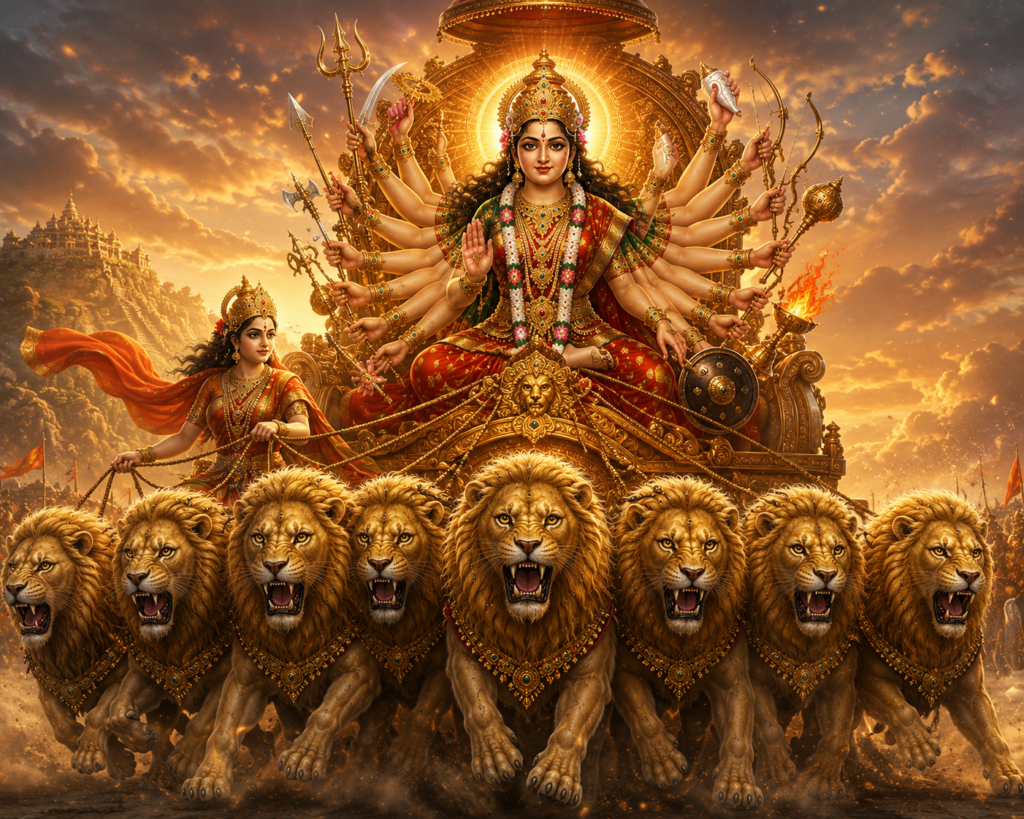
According to sacred tradition, Chamundi Hill is the very site where the Goddess slew the powerful demon Mahishasura, whose immense strength had become a threat to the cosmic order. Even today, a towering statue of Mahishasura stands upon the hill as a reminder of the eternal triumph of divine power over arrogance and evil. The temple is also revered as one of the eighteen Maha Shakti Peethas. Devotional belief holds that the hair of Goddess Sati fell at this sacred location, sanctifying the hill as a powerful center of divine feminine energy. In ancient times, this region was known as “Krauncha Puri,” due to which the temple is also referred to as “Krauncha Peetham” throughout South India. Local traditions further affirm that Lord Kalabhairava resides here as the eternal guardian and protector of the Shakti Peetha.
The theological significance of Chamundeshwari Devi extends far beyond the physical temple. It is evident from various Puranic traditions that Goddess Parvati, in her ordinary domestic manifestation, did not directly slay Mahishasura in any Kalpa. Instead, she manifested herself in her supreme eighteen-armed form to destroy the demon. Mahishasura had obtained a boon that no man could kill him, and intoxicated by this power, he challenged even Lord Vishnu and Lord Shiva. Yet neither Vishnu nor Shankara alone destroyed him, for the demon could only be vanquished by a force surpassing the combined strength, wisdom, and valor of all the gods.
Thus, to preserve the dignity and supremacy of both Shiva and Vishnu while simultaneously restoring cosmic balance, the Divine Mother manifested herself as the collective physical, mental, and spiritual power of all deities, including the Trimurti. In the Shveta Kalpa during the seventh Manvantara, Uma incarnated as Goddess Katyayani to accomplish this divine mission. Medha Rishi, while narrating the sacred tale of Chandika’s destruction of Mahishasura, describes this fierce form as Ugra Chanda, who is also regarded in the Shiva Purana as a manifestation of Bhuvaneshwari or Uma herself. This establishes that although Durga is indeed the consort of Lord Shiva, her primordial and essential nature (Moola Prakriti AshtaDashbhuj Mahalakshmi ) through which Mahishasura was annihilated. In present Kalpa, She is the eighteen-armed Chamundeshwari (Katyani)— the supreme embodiment of divine power, balance, and cosmic sovereignty.
6. Tarapith of West Bengal’s Birbhum district
Located in Birbhum district of West Bengal, the sacred Tara Peeth is one of the most important centers of Shakta Sadhana and Tantra worship in India. The deity worshipped here is Mahavidya Tara, a fierce yet compassionate form of Bhagwati Kali. Although her iconography resembles Maa Kali, she is called “Tara” because she liberates and detoxifies the consciousness of her Sadhaka, guiding the devotee towards Nirvana and spiritual awakening. Tara Peeth has been the land of great Tantric saints and hermits, most notably Bamakhepa, who attained divine realization through the worship of Maa Tara.
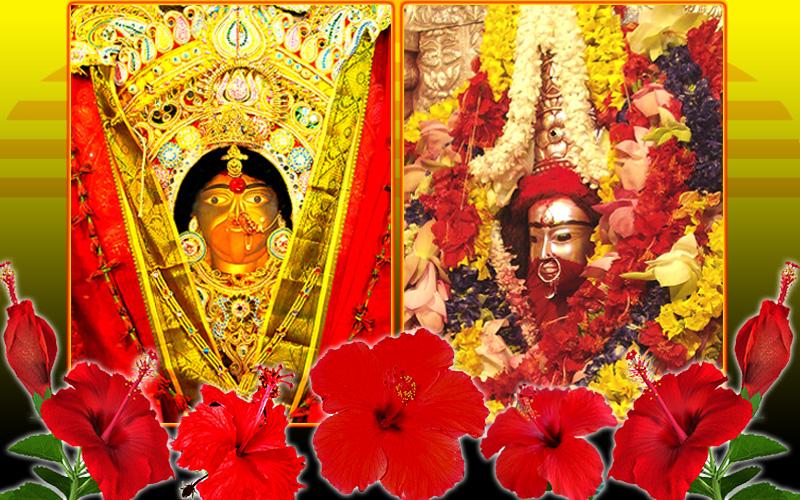
West Bengal has long been regarded as one of the greatest centers of Shakta worship and Tantric Sadhana, where countless saints and Yogic practitioners devoted themselves to the worship of the Divine Mother. Among the Mahavidyas, Goddess Tara is considered one of the most profound manifestations of Adi Shakti. Although her iconography closely resembles Bhagwati Kali, she is worshipped as “Tara” because she guides, purifies, and detoxifies the consciousness of her Sadhaka. She is believed to liberate devotees from fear, attachment, illusion, and spiritual ignorance, ultimately leading them toward Nirvana and salvation. Another difference in the iconography of Tara and Kali Maa is that Kali maa is stepping upon Shiva, while Tara Maa is stepping on Shava. Kali reperests Time, while Tara symbolizes Life.
Maa Tara blesses her devotees with a unique wisdom through which they may attain great wealth, prosperity, influence, and spiritual power, yet remain inwardly detached from worldly luxury and material pride. In Bengal, it is often believed that saints or hermits who possess wealth but continue living humbly and away from public attention are devotees of Bhagwati Tara. Though she is undoubtedly a form of Bhagwati Kali, Maa Tara carries symbols such as scissors and the lotus. The scissors represent her power to cut away inner and outer enemies, while the lotus symbolizes purity, prosperity, spiritual awakening, and ultimate liberation for the sincere Sadhaka.
5. Hinglaj Bhawani Temple, Balochisthan
Located in the rugged mountains of Balochistan, Pakistan, the sacred shrine of Hinglaj Bhawani Temple is regarded as one of the most ancient and powerful Shakti Peethas of Goddess Adi Shakti. Situated near the Hingol River within the Hingol National Park, the temple is deeply revered by Hindus, especially Shakta devotees, who consider it a place of immense spiritual energy and divine protection. According to sacred tradition, the Brahmarandhra or head portion of Goddess Sati fell at this location, sanctifying it as a supreme seat of Shakti worship.This temple is believed to be 12,000 years old. It is said to have been a place of worship since the ages of Lord Rama, Lord Krishna, and the Pandavas.
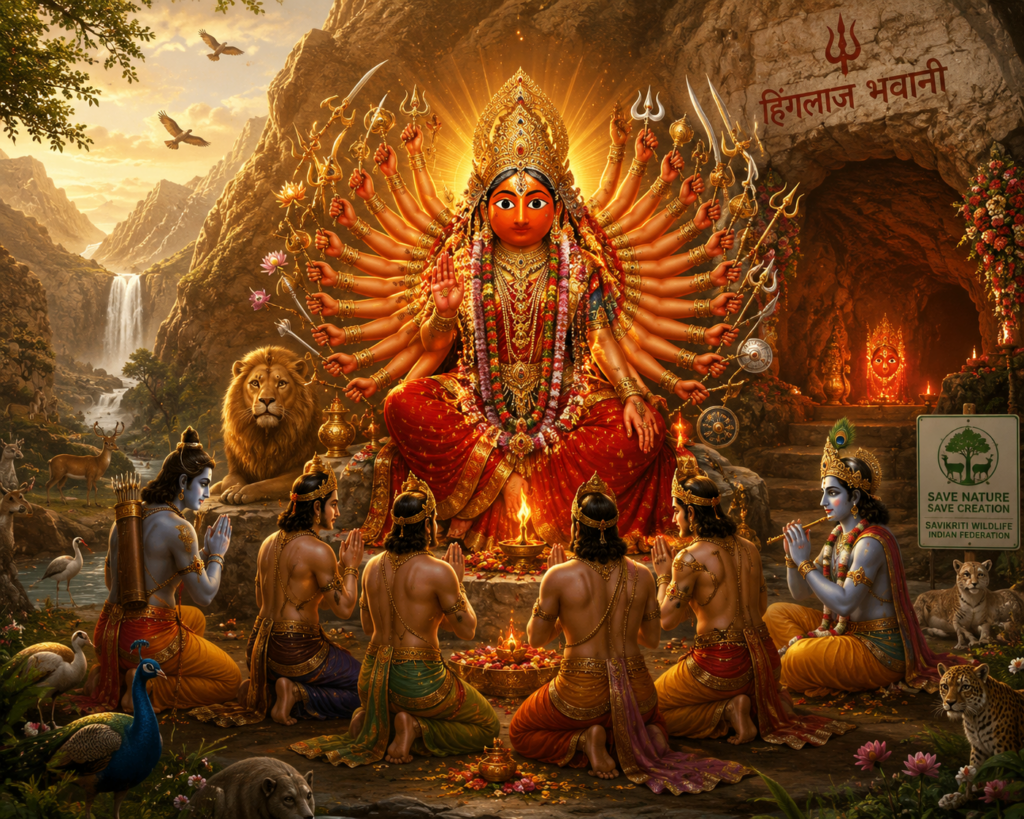
Unlike grand temple structures found elsewhere, Hinglaj Bhawani is worshipped in a natural cave shrine, symbolizing the primordial and untouched form of the Divine Mother. The deity is often referred to as Hinglaj Mata, Hingula Devi, or Nani Mandir by local devotees. The temple has historically been associated with Yogic austerities, Tantra Sadhana, and spiritual purification. Pilgrims undertake difficult journeys through deserts and rocky terrain to seek the blessings of the Goddess, reflecting the belief that true devotion requires surrender, endurance, and faith.
Hinglaj Bhawani is regarded as a fierce yet compassionate manifestation of Adi Parashakti who protects her devotees from negativity, fear, and obstacles. The shrine is especially important for Shakta and Nath traditions, where the Goddess is worshipped as the eternal cosmic energy governing creation, preservation, and destruction. Even today, despite geographical and political challenges, Hinglaj remains one of the most sacred pilgrimage centers for devotees of the Divine Mother across the Indian subcontinent.
5 – Shri Peetambra Peeth in Datia, Madhya Pradesh
Located in the Datia district of Madhya Pradesh, Shri Peetambra Peeth is regarded as both a Siddha Peetha and a Shakti Peetha of immense spiritual importance. Established by Swamiji Maharaj in 1935, the shrine is dedicated primarily to Maa Pitambara Devi, who is worshipped as Goddess Baglamukhi — one of the ten Mahavidyas of Adi Shakti. Alongside Maa Baglamukhi, Goddess Dhumavati is also worshipped here, making the Peeth a rare and powerful center of Tantric and Shakta Sadhana.
Unlike many grand temples, there is no elaborate pandal or decorated sanctum for the darshan of the Goddess. Devotees receive the blessings of the Divine Mother through a small sacred window, which adds to the mysterious and spiritually intense atmosphere of the shrine. According to devotees, Maa Pitambara reveals different divine forms during the three Praharas of the day. A devotee who witnesses one form of the Goddess in the morning may experience an entirely different manifestation later in the day. The mystery behind these changing appearances remains unexplained and is considered one of the greatest miracles associated with the temple. All the Mahavidyas are engineering studies of spiritual science. Maa Baglamukhi reperesents the spiritual communication between the hormones. Tara, Baglamukhi and Matangi the three Mahavidyas controls the communication of entire cosmos and beings. Tara works on oneself and protects sadhak by making self powerful and sontrolled. Matangi gears up the the flow and beautify the entire communication while Baglamukhi totally dissolute the external toxicity and protect the sadhak by controling the hormones of shatru or the one who are aiming to harm the sadhak.
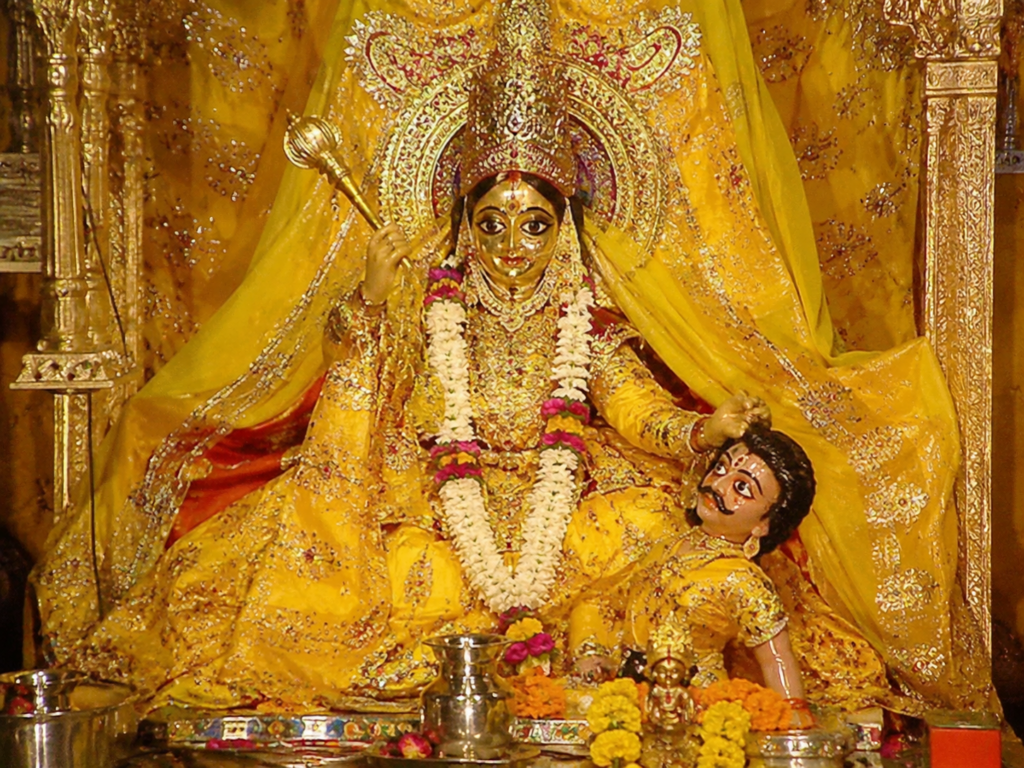
The Peeth is especially known for the worship of the yellow-colored form of the Goddess. It is believed that offering yellow clothes, yellow flowers, and yellow food to Maa Baglamukhi fulfills the sincere wishes of devotees and grants protection from negativity, enemies, and obstacles. Due to its deep association with Tantra, Mahavidya worship, and Siddha traditions, Shri Peetambra Peeth continues to attract saints, seekers, and devotees from across India.
4 – Dakshineshwar Maa Kali in Kolkata, Westbengal
Located on the banks of the sacred Hooghly River in Kolkata, West Bengal, the Dakshineshwar Maa Kali Temple is regarded as one of the most revered Siddha Peethas dedicated to Goddess Kali. The temple is devoted to Maa Dakshina Kali, the benevolent and compassionate form of Adya Kali, and remains a major center of devotion and spiritual awakening for countless devotees.
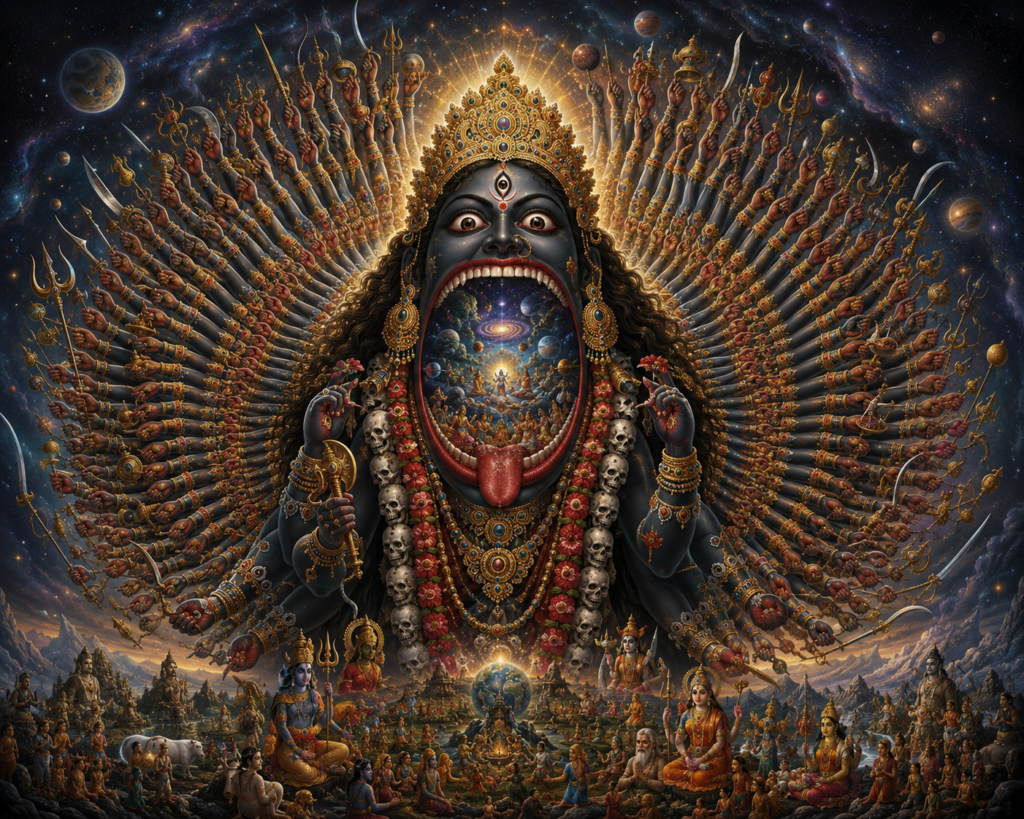
According to Shakta traditions, Goddess Adya Kali manifests primarily in three 12 forms out of which three are most important — Dakshina Kali, Mahakali, and Shamshan Kali. Mahakali represents the supreme cosmic form of the Goddess beyond time and creation, while Shamshan Kali is regarded as the fiercest manifestation who resides in the cremation grounds and symbolizes the destruction of ego, illusion, and mortality. Maa Dakshina Kali, worshipped at Dakshineshwar, embodies compassion, protection, and divine grace toward her devotees and the original Kali. Dakshina Kali is Adya Kali herself and bestows as Brahman Shakti, beyond the cosmic creation.
The establishment of the temple is closely associated with Rani Rashmoni, the famous landowner of Jan Bazar, who is believed to have received divine instructions from Maa Kali in a dream to construct the shrine. Following this sacred vision, the construction of the Dakshineshwar Temple began in 1847. The temple later became deeply associated with the great saint and mystic Sri Ramakrishna Paramahamsa, whose intense devotion and spiritual practices transformed the temple into a renowned center of Shakta spirituality and Bhakti.
Devotees visit the temple throughout the year seeking the blessings of Maa Kali, but during Navratri and Kali Puja, the spiritual atmosphere becomes especially vibrant, attracting thousands of worshippers from across the country.
3 – Vindhyachal Mahapeeth at Mirzapur, Uttar Pradesh
Located on the sacred Vindhyachal Mountain near Mirzapur in Uttar Pradesh, the revered shrine of Bhagwati Vindhyavasini Devi is regarded as one of the most awakened and powerful Shakti Peethas of Adi Shakti. Vindhyachal has eternally been considered the divine abode of Jagadamba, whose continual spiritual presence sanctifies the entire region. Maa Vindhyavasini is worshipped as the supreme Mahashakti who protects, nourishes, and governs the universe through her divine energy.
The glory of Vindhyavasini Devi is mentioned in several sacred scriptures. In the Virat Parva of the Mahabharata, Dharmaraja Yudhishthira praises the Goddess, saying, “O Mother, You eternally reside upon the mountains of Vindhyachal.” Similarly, the Padma Purana refers to the supreme cosmic power by the name of Vindhyavasini. The Tenth Skanda of Srimad Devi Bhagwat narrates that Lord Brahma created Swayambhuva Manu and Shatarupa from his mind. After their marriage, Swayambhuva Manu performed severe austerities for a hundred years by personally crafting and worshipping an idol of the Goddess. Pleased by his devotion, Bhagwati blessed him with prosperity, lineage, spiritual success, and the highest divine state before manifesting herself upon Vindhyachal Mountain. This sacred narrative establishes that Maa Vindhyavasini has been worshipped since the very beginning of creation.
The Vindhyachal region is also associated with two other important shrines, forming the sacred Trikon Vidhan of the Peeth. One shrine is dedicated to Bhagwati Kali, popularly known as Kali Khoh, while the other is dedicated to the eight-armed manifestation of the Goddess. The three principal manifestations worshipped in this region are Nanda Devi, Kali, and Vindhyavasini Kanak Durga, also known as Vindhyeshwari Devi.
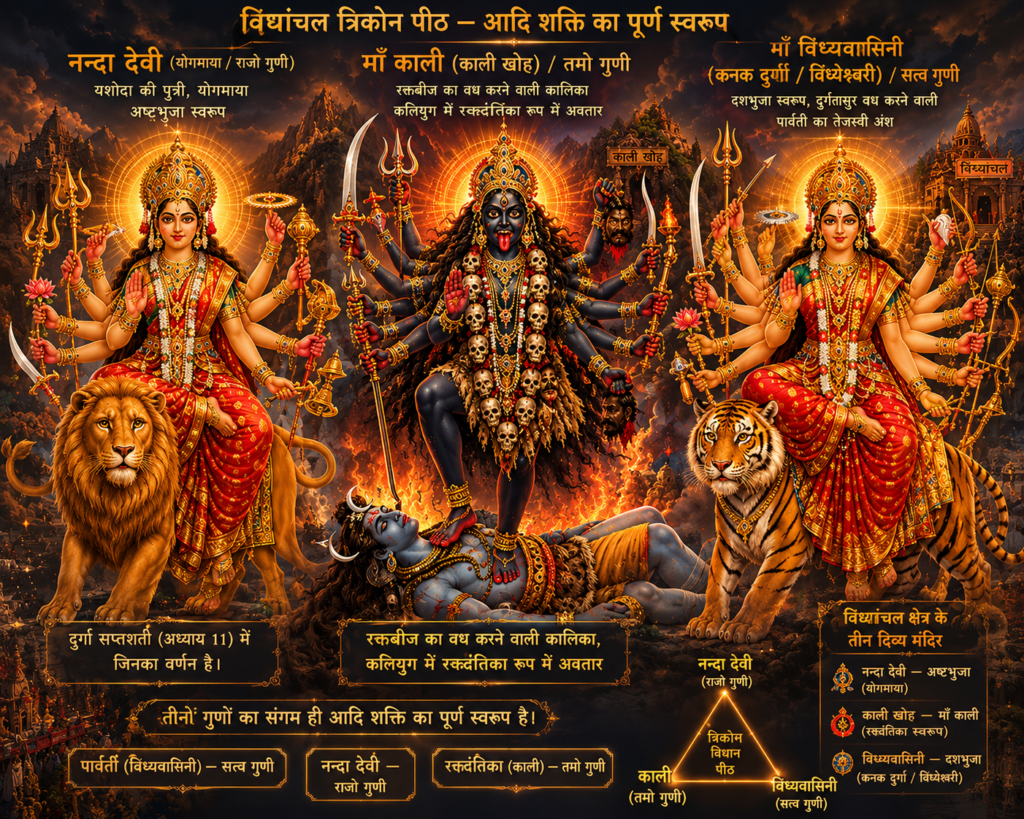
Nanda Devi is regarded as the daughter of Yashoda and the Yogmaya who was exchanged by Vasudeva in place of Lord Krishna. According to tradition, when Kansa attempted to kill the divine child by throwing her to the ground, she slipped from his hands and manifested herself as the eight-armed Goddess. Her glory is also referenced in the eleventh chapter of Durga Saptashati. Kali Khoh is associated with Maa Kalika, the fierce form of the Goddess who slew the demon Raktabeeja. It is believed that in Kali Yuga she will again manifest as Raktdantika to destroy demonic forces. The third and principal deity is the ten-handed Maa Vindhyavasini, who slew the demon Durgamasura and thereafter came to be known as Durga. She is regarded as the manifestation of Parvati herself.
In the spiritual understanding of the Peeth, Parvati or Vindhyavasini represents the Sattva Guna, Nanda Devi embodies the Rajo Guna, and Raktdantika or Kali represents the Tamo Guna. The union of these three manifestations establishes the complete Triguna Swarupa of Adi Shakti. Hence, the Goddess is believed to reside at Vindhyachal in her complete and unified cosmic form.
2. Mata Vaishno Devi Temple – Katra, Jammu and Kashmir
Located on the sacred Trikuta Parvat near Katra in Jammu and Kashmir, the revered shrine of Mata Vaishno Devi is one of the most visited pilgrimage destinations in the world and among the most important spiritual centers in India. Millions of devotees from across the country undertake the sacred journey to seek the blessings of the Divine Mother and to witness the holy three Pindies representing Mahakali, Mahalakshmi, and Mahasaraswati. These three eternal manifestations symbolize divine power, prosperity, and wisdom respectively.
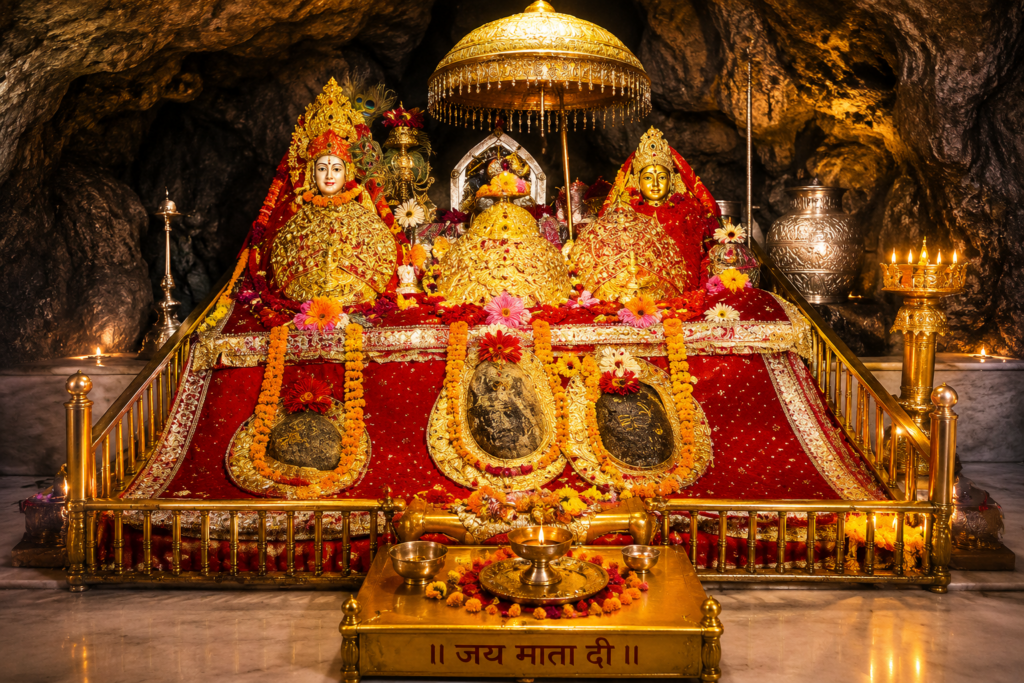
According to sacred traditions and folk literature, Goddess Vaishno Devi manifested to destroy the demon Bhairavnatha, whose arrogance and misuse of spiritual powers disturbed the balance of Dharma. After slaying him, the Goddess granted liberation to Bhairavnatha, and his shrine continues to exist near the holy cave as a symbol of divine compassion and forgiveness.
Mata Vaishno Devi is regarded as the unified embodiment of the spiritual essence of Goddess Lakshmi, the power and protection of Mother Kali, and the divine knowledge of Goddess Saraswati. Thus, the shrine represents the combined cosmic energies of the three supreme manifestations of Adi Shakti. According to Devi Bhagwat Mahapurana, Vaishno Devi is also counted among the 108 sacred Siddha Peethas of the Goddess, making the temple one of the holiest centers of Shakta worship in Bharat.
1 Maa Kamakhya Devi at Guwahati, Assam
Located atop the Nilachal Hills near Guwahati in Assam, the sacred Kamakhya Devi Temple is regarded as one of the most powerful and revered among the 51 Shakti Peethas and Siddha Peethas of Adi Shakti. Situated around 8 kilometers from Dispur, the capital of Assam, the shrine is considered the supreme center of Tantra Sadhana and Shakta worship in Bharat. According to sacred tradition, the yoni (vaginal portion) of Goddess Sati fell at this location, making Kamakhya the eternal symbol of creation, fertility, feminine power, and cosmic energy.
One of the most mysterious and spiritually significant events associated with the temple is the annual Ambubachi festival. It is believed that during this sacred period, the Goddess undergoes her divine menstruation, and the water flowing within the sanctum turns red for three days. During this time, the temple remains closed, and after the completion of the ritual period, thousands of devotees, saints, Aghoris, and Tantrikas gather to seek the blessings of Maa Kamakhya. The temple has long been associated with deep Tantric practices, mystical rituals, and spiritual disciplines, making it one of the most esoteric pilgrimage centers in India.
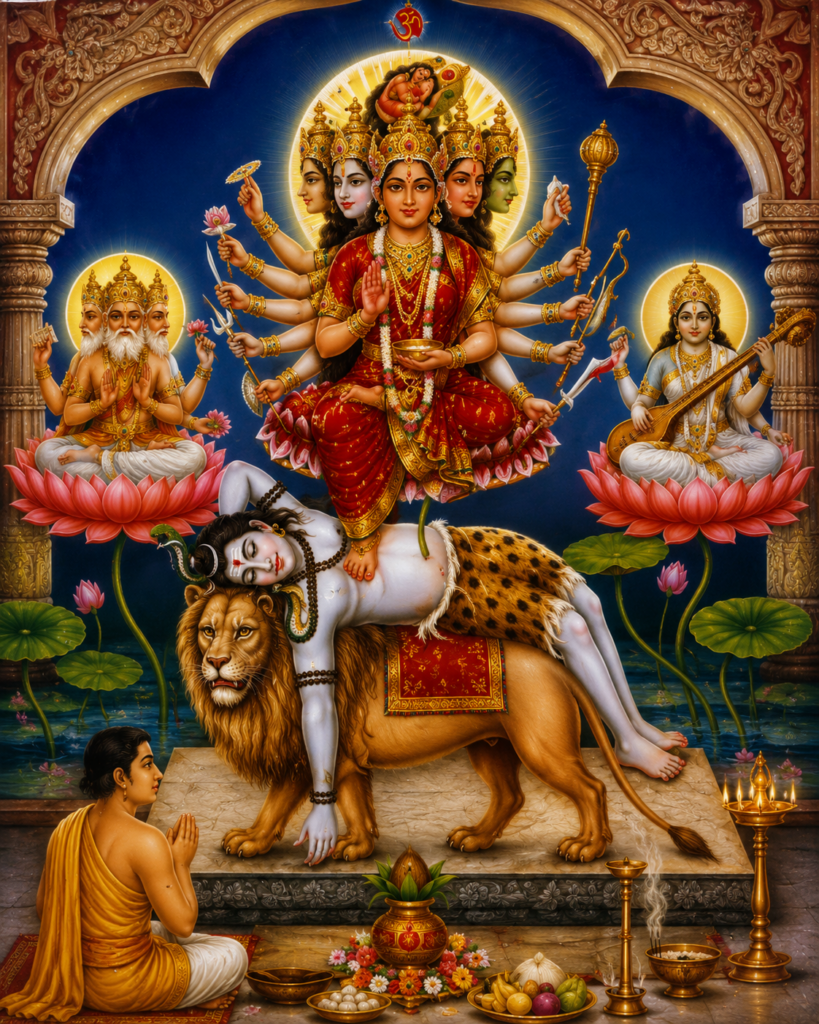
Near the sanctum, a natural underground water stream continuously flows, symbolizing the divine feminine energy of the Goddess. Devotees believe that this sacred water possesses healing and purifying powers capable of removing diseases, negativity, curses, and the effects of black magic. Maa Kamakhya is worshipped not only as the Goddess of desire and creation but also as the supreme force who grants liberation, protection, and fulfillment of wishes.
According to sacred traditions, Goddess Kamakhya also played a role in assisting Lord Krishna in the destruction of the demon Narakasura. Another important legend states that after Lord Shiva reduced Kamadeva to ashes through the fire of his third eye, Goddess Kamakhya blessed Rati and granted a boon that Kamadeva would be reborn as the son of Lord Krishna. Thus, Kamakhya Devi is revered as the divine source of both cosmic creation and spiritual transformation.